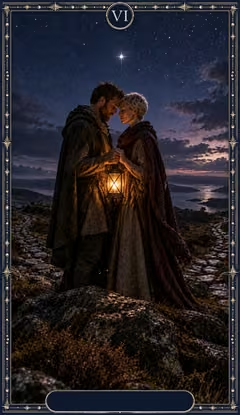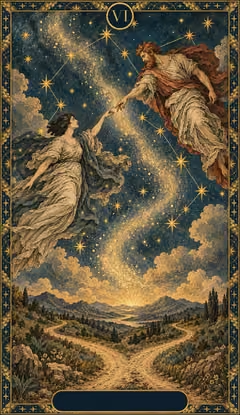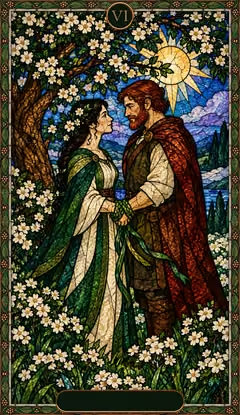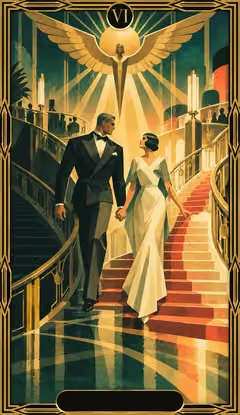
The Lovers upright
The Lovers is the card of choice. You are facing a decision that commits your life, because the two paths open to you are two ways of directing your will and your loyalty. This decision is not made with reason alone: it touches your heart, your desire and what you aspire to. The choice may be small or become a real crisis, and it may extend to your whole life. The two classic paths are a respectable but perhaps dull life, and a much desired but morally questionable one. What you were taught no longer protects you as it did: you must commit, and so set limits, choose and decide. You are free to turn toward the demands of duty or toward the pleasures of life, and it is up to you to decide whether you really want to live or let yourself drift along. This card speaks of emotional responsibility: you direct your strength, your loyalty and your will to live toward what you recognize as right.
It marks the moment when you stop following your parents' expectations. Until then, most people are content to answer what their parents expect of them, and your first real choice is made independently of them. Living under your parents' protection is safe and comfortable, but you become a person in your own right only by making a break. The partners that parents would choose are rarely the ones you choose yourself, and if the gap is too wide or the parents too controlling, the choice can be painful. You then assert your own personality, your ideas and your goals, and you choose according to your own assessment of your desires and responsibilities, not on orders.
It shows how an act of will works: you receive impressions through your sensitivity, you react, then you deliberate and choose before acting. Your desire is intense and carried by a deep affection; love absorbs your will, and you no longer try to command. The outcome of this card is a love that makes you forget your personal interest so that you want only the good of others.
It speaks of your relationships of every kind: family, friends, colleagues, romantic ties, spiritual life, and also the different parts of yourself. It may concern a cooperation, or someone close who influences your thinking or a decision. Since Gemini puts communication at the center, you want to exchange your thoughts and opinions. It also says how important love is in your life and of one particular relationship, often a marriage or a long relationship. This relationship is very precious to you and can lead you to a new understanding of life. If you are facing a specific problem, the card indicates help, either practical from the person you love or emotional support. Depending on the case, it speaks of union and marriage, sometimes of several unions or of a choice to make: it is a strong, positive card. It is the card of human love, of youth and innocence, of love before coarse material desire stains it. Love and sexuality pull you out of isolation and push you to form vital relationships. In loving, you let go of some control of your ego, the part that isolates you from others and from life. It also touches discernment, the knowledge of good and evil, conscience, privilege and duty, instinct. You may want to show yourself as you are, hiding nothing, and be accepted that way. Love can free you from inhibitions or guilt. You may have to reconcile a duality in yourself, or look for a higher perspective that takes in your options, even a spiritual union rather than a physical one. Your sense of worth may reflect the way a partner treats you. Your choices bring you knowledge and experience, and this card tests your maturity by asking for discernment.
Your strengths
You feel tenderness, attraction, affection, love and trust. You look for balance, harmony, agreement with the other person. You know how to make wise choices, you determine yourself and you take responsibility.
What holds you back
- You hesitate and find it hard to adopt a line of conduct.
- You are divided in your feelings and can contradict yourself.
- You can fall into childishness, frivolity or triviality, and think without taking the concrete into account.
- An infatuation can put you under the sway of an unconscious compulsion.
- If you spend your will without sparing it, your decisions lack force.
What helps
Choosing with your whole being and not only with your head. Asking yourself what you give your strength, your loyalty and your will to live to, what you want to serve and which bond you recognize as right. Uniting reason and passion: each needs the other, reason guides the passions and the passions free reason. Looking at what you love most and who or what you take as a companion. Showing yourself with nothing hidden. Sparing your will, so that your decisions have force. Exchanging your thoughts with others.
The Lovers reversed
The reversed Lovers speaks of your ties, of how you move toward someone and of your choices. Your bond with a person may be mainly inner: a union of minds more than of bodies, or a deep understanding that material circumstances keep you from living out. You may idealize someone, especially if they are absent, or simply the idea of being a couple. Your relationship may also be difficult, disharmonious, immature or unhealthy, especially in the areas the neighboring cards show. You may find it hard to communicate, or not know how to approach someone. Confusion sets in, and disagreements or misunderstandings give rise to conflict. It may also be that no relationship is in sight, or that you are disappointed because a coming together did not work out.
This card also speaks of choices. You may lack discernment and make poor choices that leave regret and guilt, especially when another person is involved. You find it hard to decide or you put off your next decision, and this can end up forcing an ultimatum on you. You may be torn between your attachment to the other and your loyalty to yourself, and stay stuck. You may fear a separation, even a temporary one. If you move away from the other, you do not know how to find a real bond again. Projection is a major issue here: you attribute to the other what comes from you, and you need to see yourself through their eyes.
Your strengths
When you work consciously to bring together your two sides, the masculine and the feminine in you, this card shows an inner balance.
What holds you back
- You idealize an absent person or the idea of a relationship.
- You stay in a disharmonious or immature relationship.
- You find it hard to communicate or approach the other, which feeds misunderstanding and conflict.
- You let yourself be seduced, or you seduce, without love; or your love is not returned.
- You suffer from jealousy, envy or possessiveness.
- You turn toward pleasure for its own sake, to the point of indulging in it.
- The other person controls you too much, or you struggle for dominance.
- A union smothers your individuality.
- You lack discernment, you hesitate and you delay your decisions.
- You doubt, you lack confidence, you are disillusioned, and you may act in an immature or disorderly way.
What helps
Recognize that you may simply need space right now. Looking at what you project onto the other and seeing yourself. Integrating your masculine and feminine qualities. Choose between what you owe the other person and what you owe yourself, instead of staying suspended between the two.
Love
You may idealize someone or the idea of a relationship, live a difficult or immature bond, or be disappointed that a coming together did not work out. You may suffer from jealousy, envy or possessiveness, frustration or sexual incompatibility, and your love may go unreturned. When you move away from the other, you do not always know how to reconnect.
What the card shows
What the image shows
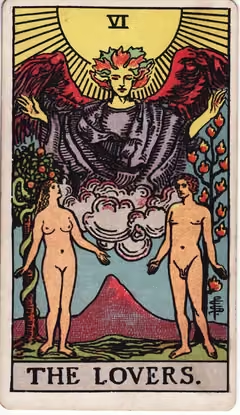
In the most common version today, the sun shines at the very top and a large angel with outstretched arms sends his influence down onto two figures. In the foreground, a man and a woman stand nude facing each other, like Adam and Eve entering paradise. Behind the man is the tree of life, which bears twelve fruits. Behind the woman is the tree of the knowledge of good and evil, with the serpent coiled around it. This tree bears five fruits, which point to the life of the senses. The man looks at the woman, the woman looks at the angel, and a single mountain rises between them. The nudity of the two figures says that they hide nothing from each other and accept each other as they are. The figures evoke youth, innocence and love before it is spoiled by crude desire.
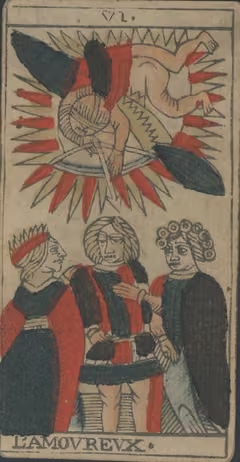
In the older version, the young man has his arms crossed on his chest and his eyes lowered, not knowing which direction to take. One woman wears a gold circlet on her head, the other has loose hair and a crown of vine leaves. They stand for virtue and vice, each showing him a path. The first promises a life of effort and moral satisfaction, the other easy pleasures. His costume alternates red, the color of energy and courage, and green, the color of passive vitality and inaction. This version sometimes bears the title "The Choice." It goes back to 15th-century scenes about the choice of a marriage, an allegiance or a direction.
What the card means
The central theme is choice. The two figures around the young man stand for two possible orientations of life, two loyalties, two ways of ordering your will. The choice can be small or mark a crisis, and it can commit a whole life. It often sets what is respectable but perhaps dull against what is strongly desired but morally improper. The arrow from above shows that the decision touches the center of your being: you choose with everything you are, not only with your reason. The card speaks of emotional and spiritual responsibility: freedom becomes concrete because it forces you to decide.
The card also marks the first real choice made independently of your parents. As long as romantic desire has not awakened, you respond mostly to what your parents expect, and it is rare that the partners they would choose are the ones you choose yourself. If the gap is too large or the parents too controlling, the choice can be painful. Life under your parents' protection is safe and comfortable, but you only become a real person by breaking away from it. This card thus stands for adolescence, with intellectual and moral independence, where the personality appears with its own ideas and goals.
In the current version, the card shows the role of love in a life. Desire pushes you out of isolation to create ties, then opens the way to love. In love, you release some of your ego's control, and you glimpse a greater meaning in life. The angel above the two figures is a vision that neither of them gets alone. Man and woman stand for duality: the man stands for reason and the woman for sensitivity and desire. The woman, who looks at the angel, shows that reason goes beyond its limits thanks to passion. These two forces nonetheless need each other: passion alone throws you from one experience to the next, and reason alone stays locked in control. Whoever refuses all romantic feeling can fall into depression, and whoever never lets go of the ego uses sexuality to take power over the other. The two figures can be any couple: what matters is the reality of the union, not the roles.
The angel stands for higher consciousness, which gives the right direction. Left without direction, deep consciousness lets itself be governed by the appearances of the senses. The two parts of you are different but equal: neither has to dominate the other and they must hide nothing from each other. Someone who plays a role all the time, with words and a face that say something other than her thoughts, suffers from the conflicts of her own mind.
The card can also be read as a bond between opposites: the struggle between passions and conscience, or between contrary ideas, which becomes love when it brings the opponents together. The young man is also the one who deliberates before acting: he receives the impressions of the world through his sensitivity, reacts, and chooses before deciding. Cupid accumulates the energy of will above him, and if you spend it without saving it, your wishes lose strength. The Lover is content to desire intensely in a feeling of deep affection, and love absorbs his will. At its peak, the card speaks of loving to the point of living for others and wanting only the good of others.
The card is tied to the sign of Gemini, and so to communication, the exchange of thoughts and opinions. It is linked to the Hebrew letter Zayin, the sword, and to the faculty of discerning and separating.
Your strengths
You can show yourself as you are, without a mask. You are capable of affection, attraction and a love that opens you to something bigger than yourself.
What holds you back
- You hesitate, you delay your decision, and you find yourself torn between two directions.
- You sometimes lack discernment and make choices you later regret.
- You can idealize a person, especially an absent one, or the very idea of a relationship.
- You can be led by an attraction that acts like an unconscious compulsion.
- You risk projecting onto the other what is going on inside you.
- You can experience love as a big problem, or stay in childhood fantasies as an adult.
- You can stay attached to a past love to the point of refusing to look at the present.
- You can end up in a union where the other person controls you or where your power struggle stifles your individuality.
What helps
- Ask yourself what you love most, and who or what you choose as a companion.
- Reconcile the two parts of yourself without letting one dominate the other.
- Ask for space when you need it.