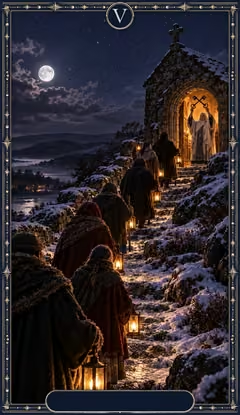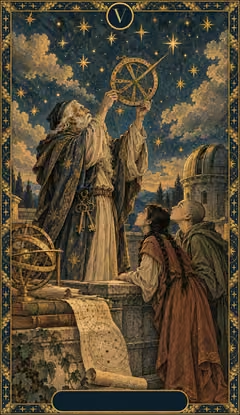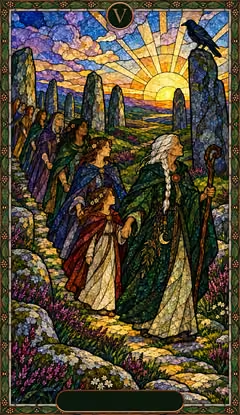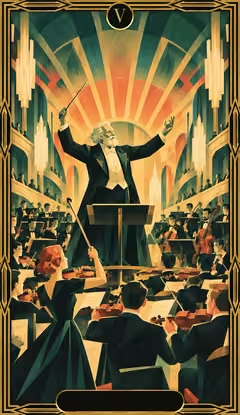
The Hierophant upright
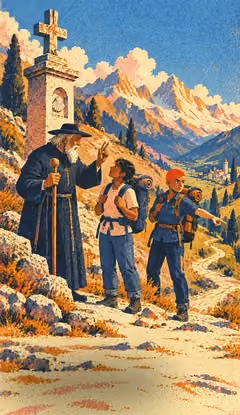
The Hierophant speaks of teaching, counsel and learning. He represents the "shoulds" in your life, those that link you to traditional values and established knowledge, and that shape your conscience. In your situation, you are taking or giving a course, learning what has proven itself and trying to apply spiritual truths in practice. You may be trying to join a group, a way of life or a higher level of growth, through a guide, a religion or a teacher, or by taking that role yourself. The advice you ask for or give rests on established sources. You may also be dealing with large organizations and institutions.
The card points to education and tradition: it stands for the intellectual tradition of the society you live in and the education you received there. It stands for churches, doctrines and education in general. Psychologically, it speaks of orthodoxy, of conforming to the ideas and codes of your society, and, more subtly, of giving up responsibility; it shows your own sense of obedience.
The card also speaks of conscience, duty and moral law, with a measure of restraint: you have to refrain from doing wrong before devoting yourself to good. It touches religious science, metaphysics, teaching and knowledge, authority and certainty. It gives an influence over the feeling and thought of others, and a role that brings prestige. Its action is spiritual: it stays apart from material affairs. It has to reconcile opposing tendencies and make lofty truths accessible to simple people. Its will is powerful only if it agrees with a more general power, and holding back from willing at the wrong time is part of its strength.
It also signals vocation: a secret revealed, a religious or scientific calling; it is a strong, positive card. In traditional readings, it announces inspiration, union, alliance and marriage, mercy, kindness and forgiveness, teaching and good counsel, but also constraint and servitude. Blessing and the forgiveness of faults can be a relief for you. You may have a simple faith, or make commitments that bind you to a specific path.
As for the will, the card asks you to bring your personal will into agreement with a will higher than your own. The strength you exercise no longer comes from you alone: you receive it, regulate it and pass it on. Your true authority lies in connecting, not in dominating.
Finally, it speaks of intuition: an inner teaching that helps you overcome an obstacle, avoid a danger and turn an unfavorable situation into cooperation. True intuition follows good reasoning and does not replace it; it does not speak to the woman who refuses to study, observe, remember and reason. It does not flatter, does not demand and does not raise your sense of personal importance; everything it teaches you can be checked by reason. This inner wisdom has value only if you put it at the service of the outer world.
Your strengths
You have a stubborn strength, placidity and a good heart, and you know how to explain and teach. You can count on help from people who have more authority than you. You rely on a solid tradition to judge new ideas and information.
What holds you back
- You can be dogmatic, rigid and closed to questions.
- You may conform to society's ideas without examining them and leave the responsibility for your life to others.
- You may prefer to be told what to do and what to think, because deciding on your own what is right takes constant effort.
- You may feel constrained or captive.
- If you defend an authority or an institution, you risk valuing obedience more than understanding and making power an end in itself.
- After rejecting one doctrine, you may adopt another that is just as rigid and more superficial.
What helps
- Relying on a tradition or a teaching to give your personal development a base.
- Looking for a guide or a teacher, or being one yourself, relying on established sources.
- Studying, observing, remembering and reasoning first. Then, ceasing to rack your brain over a problem and staying quiet to listen for your intuition; calm is the price of that answer.
- Not giving your will an artificial force: holding back from willing at the wrong time.
Careers
teaching, moral counsel, spiritual guidance, roles tied to institutions and administration.
Work
You are patient and organized, and you can count on help from superiors.
The Hierophant reversed
The upright Hierophant represents doctrines, teaching and the rules of society, and it also speaks of your own sense of obedience. Reversed, it speaks of your relationship to rules, customs and authorities: religious, corporate, governmental or school.
You question conventions, disobey rules, doubt moral principles or reject the religious education you received. You want to choose your own standards rather than accept those of the powers that be. You may come into confrontation with an institution, and feel like openly disobeying or rebelling. On the mental level, this position gives original ideas that lie outside accepted frameworks.
Your conscience may torment you: the "shoulds" and "oughts" wear you down. You may consider something immoral or against your principles. In a daily draw, the card may simply show improper behavior, a small fault you feel ashamed of.
The card can also show the opposite excess. You can be too rigid and dogmatic, and cling to outdated ideas or to principles that do not fit. You may judge yourself harshly, or let someone else censor you and accept their negative view. You may fear being excluded or rejected. You may realize that the path you committed to is limited and restrictive. You or someone else may come across as pretentious, preachy or arrogant. You may rely on unproven principles, out of pure blind faith.
Your thinking may go in circles, with rusty habits. At the other extreme, you may lack conviction and be timid about defending your beliefs. You may be confused, no longer able to tell right from wrong, or torn between two good or two bad options. The card can also indicate a break with tradition.
When you project this card onto another person, you may see them as your access to spiritual truth, purer than other people. You may also see them as someone who makes impossible demands, sticks to the letter rather than the spirit of the rule, or is hypocritical. You may then feel betrayed by those you admire or by the system.
Reversed, the card also means gullibility. A society builds its intellectual tradition over centuries, and that tradition gives a reference point for judging new ideas. Those who reject it have to find their way alone and easily get lost in superficial ideas. Many people abandon the dogma imposed in childhood only to fall into a new dogma, a sect or an extremist group, just as rigid and sometimes more superficial. In rejecting tradition, they have not really rejected the Hierophant: they have not taken responsibility for finding their own way.
In the meaning given to it in the Marseille tarot, the reversed card indicates a delayed project and a late vocation. The upright card is a strong, positive card: it announces a religious or scientific vocation. Following the Emperor, the reversed Hierophant says that by abandoning knowledge, you lose wealth and earthly power.
The words tradition attaches to this reversed card: society and the institution, too much kindness and thoughtless generosity, weakness, misplaced intimacy or familiarity, vulnerability to influence, impure mixture, nonconformity, rigid morality and inflexibility, renunciation.
Your strengths
You have an independent mind: you question authority and want to choose your own standards.
What holds you back
- You can rebel against rules without knowing what you want to put in their place.
- You judge yourself harshly, or you let someone else judge you.
- You can stay rigid, dogmatic, attached to outdated ideas.
- You can lack conviction and hesitate to defend what you believe.
- You can be gullible and fall into a new dogma after rejecting the old one.
- You can feel betrayed by those you admire, or expect someone else to be purer than other people.
- You can feel guilty under the weight of the "shoulds."
What helps
Choose your own standards rather than accepting those of the powers that be. Taking responsibility for finding your own way, rather than switching from one dogma to another. Looking at where your ideas have become rigid and where you lack conviction.
What the card shows
The image
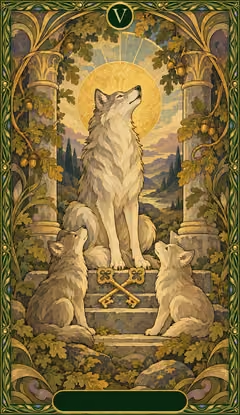
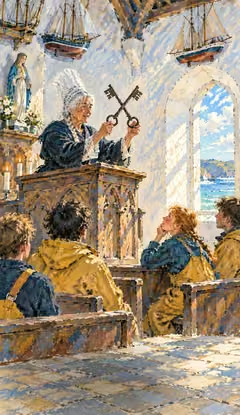
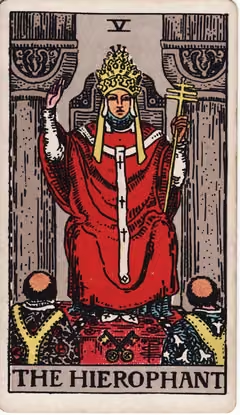
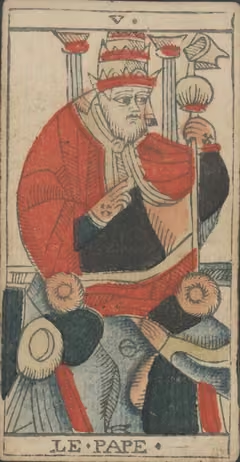
The Pope, also called the Hierophant, sits between two pillars and wears the triple crown. In his left hand, he holds a scepter ending in a cross with three crossbars. With his right hand, he makes the sign that separates the visible part of the doctrine from its hidden part. Two keys cross at his feet. Two ministers in albs kneel before him. In the Tarot de Marseille, he has a ruddy complexion, full cheeks, very light blue eyes and a short, neat white beard. His hands are gloved in white and each carries a blue cross.
What the image means
The Pope stands for visible religion, that of institutions, doctrine and received teaching. He is the order and head of a recognized hierarchy, and he guides people toward their salvation. He holds the power of the keys: the outer, orthodox doctrine, and the outer side of life that leads to it. The card therefore speaks of education and tradition: it comes after the natural world and society, and it points to the intellectual tradition of your society and the instruction you receive in it.
The Pope is the Emperor's companion. The word "pope" means "father": one meets physical needs, the other guides spiritual growth. The Emperor stands for the law and order that structure the world. The Pope restores the link between above and below, and he connects rather than rules. In this card, attention turns inward, while the Emperor's turns toward the outside world.
The number five points to the five fingers of the blessing hand and to the five senses. It is also the number of the human being, mediator between God and the universe: the head dominates the four limbs as the spirit commands the four elements. Individual will is strong only if it agrees with a more general power. The Pope receives this force, regulates it and passes it on.
The details of the image
- The three crowns of the tiara and the three crossbars of the cross say that his action is spiritual and that it operates on three planes.
- The white gloves show that his hands stay pure and do not mix in temporal affairs.
- The keys bind what is scattered and free what is shut in: they serve to restore circulation, not to close off the world.
- In one version of the tarot, both keys are gold: the hidden side stays unknown to those who follow only the outer doctrine. In other versions, one is gold and the other silver, to unite the outer way and the inner way.
- The pillars are not those of the High Priestess's temple. They are a dull gray: those who enter here find protection, but they do not pierce the secret of duality, and the unconscious stays closed.
- Their clothing is embroidered with the flowers of the Magician's garden: the lilies say acquired knowledge, the roses the development of desires.
- A large figure presiding over two smaller ones reappears in the next card with the angel above the Lovers, then with the charioteer above the two sphinxes of the Chariot.
A card of mediation
The Hierophant, the Lovers and the Chariot all try to hold in balance the opposite poles of life, without resolving them. A religious doctrine answers the great questions, but the contradictions of life stay open.
The Hierophant as inner voice
It also stands for inner listening, which lets you know the voice of your true self. The general meaning of the card is intuition, inner teaching. She comes after the Emperor: true intuition is the result of sound reasoning and does not replace reflection. An inner voice that demands to be obeyed, that flatters, or that increases your sense of importance is to be set aside. A true inner counsel can always be checked by reason.
The meaning in a spread
The card points to Churches, doctrines and education in general. It speaks of what you ought to do, of what ties you to traditional values and established knowledge, and it forms your conscience by teaching you the laws. It can also show that you are taking a course or giving one, that you are looking for the keys to a group or a new level of life, or that you are dealing with large institutions. The word "hierophant" names the one who makes the sacred intelligible, and in you this can mean bringing out your genius or innate quality. Its meanings are inspiration, union, alliance, marriage, mercy, kindness, clemency, duty, morality, conscience, conformity, respectability, reserve, forgiveness, teaching and good counsel. Its keywords also include tenacious strength, work, endurance, calm, patience, organization, peace, kindness of heart and help from those above you. It also announces captivity, servitude and the man to whom the querent turns for help.
Your strengths
You know how to lean on a tradition, which gives a solid base on which to build your personal development. You have patience, endurance and a sense of organization. You have a sense of duty and moral conscience.
What holds you back
- You conform to the ideas and codes of your circle, and you may give up your own responsibility.
- You follow a doctrine or a group, and you reject the tradition of your childhood only to fall into another doctrine just as rigid, such as a sect or an extremist group.
- You risk captivity or servitude.
- You risk confusing your position with everything it stands for and acting as if you contained the whole truth.
What helps
- Take tradition as a starting point: it gives a framework for your own work.
- Cultivate a critical mind in faith as in everything: the first of the two followers does not follow with eyes closed, but adapts what he is taught.
- Reflect, observe, remember and imagine first, then stay still and silent to listen when a problem is left unanswered: the harder you force it, the less you hear.
- Hold back your will and do not will out of place: what you have kept back makes your decisive action stronger.
- Check your ideas in the light of reason.