Death upright
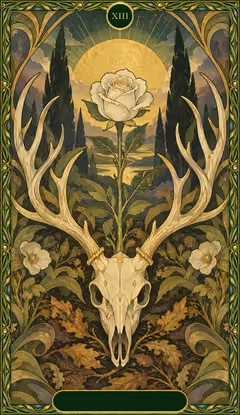
Card 13 is Death, and in the Tarot de Marseille it carries no name: it is identified only by its number. It speaks of transformation: something in your situation is ending so that something else can come. It describes a passage to another form of life, with the idea of rebirth, creation and renewal.
What ends are the forms that have become sterile: illusions, attachments, habits, mental structures or ways of being that now stand in the way of your growth. Depending on your situation, it can also be a project or a job that stops, a stagnant environment you leave, friendships you have outgrown. The change may be wanted or imposed: it follows logically from what already existed, and yet it can arrive suddenly and unexpectedly. The destruction it seems to bring is only apparent: what ends changes form and frees the energy that will serve new forms of life.
This card shows the exact moment when you drop your old masks and let the transformation happen. The person those habits had built ceases to exist, and something else appears. It comes after the Hanged Man: having agreed to let go of your old supports, you enter a deeper change. On the inner level, it speaks of dying to your usual way of thinking, by breaking with the prejudices that are dear to you. When the ego dies, its selfish and repressive needs die with it.
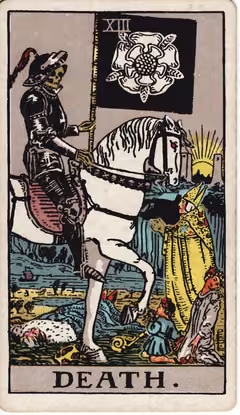
You may feel great relief on seeing this card, sometimes mixed with sorrow: the waiting and the apprehension end and you can move forward. The number 13 adds up to 4, the number of the Emperor, and, as a higher form of 3, it recalls the Empress: in nature, life and death are inseparable. In the image, a sun rises between two pillars in the background: through death, you sense the radiant power of life.
In astrology, the card corresponds to Scorpio, the eighth sign of the zodiac, which rules the 8th house, the house of death and inheritances. Among its traditional meanings are inheritance, the influence of the dead and atavism. This card is never read as the announcement of a real death.
What holds you back
- You may fear the change that this card often indicates.
- You fear that nothing of you will remain if you give up your habits.
- If you are rigid, a very strong change can make you collapse.
- You can stay aware of yourself without agreeing to yield to change.
- Your ego holds back your energy out of fear of dying, and the new energy can no longer enter.
- The card is associated with melancholy, mourning and sadness.
- At its most negative, the card indicates a paralyzing fear of physical death, deeper than many people realize.
What helps
- Clearing away everything that isn't essential to find what truly supports you.
- Letting go of your personal will and of forms that have become useless.
- Accepting that this may take a time of sorrow and grief.
- Accepting the idea of death so that you can live more fully.
- Facing change with simple innocence, like the child in the image who offers flowers to Death.
- Relying on a set of beliefs that helps you move past your fears, like the priest in the image, who is protected and supported by his stiff robes.
- Breaking with the prejudices that are dear to you and dying to your usual way of thinking, to be born into freedom of thought.
- First picturing the new way of living that you want: the mental image comes before the concrete change.
Death reversed
Reversed Death is harder to live with than the upright card when you try to resist an unavoidable change. You delay or avoid the end of something, you fool yourself, you prolong your pain and you keep something new from growing. You worry in advance about something you fear, especially if you judge it bad or harmful, whether or not the fear comes true. You may feel that something or someone is pursuing, harassing or pestering you.
The card also describes situations where you stay alive without really living: inertia, too much sleep, weariness, stillness, all kept going by assorted fears and insecurities. It points to a pessimistic state of mind rather than a real misfortune, but that pessimism is enough to make even the loveliest day dull. The traditional meanings point the same way: inertia, sleep, lethargy, immobility, discouragement, hope and plans dashed. Change is slow or partial, or it turns out to your advantage.
This card can also mean the opposite: you are coming out of a period of stagnation or sadness and you find your zest for life and your pleasure in the senses again. You are recovering from a bereavement or a sorrow. Something you thought was over may come back, for example an old interest reawakening. You may also be drawn to death, the morbid or the gothic, try to communicate with the dead or take an interest in spiritualism, or on the contrary reject all of it.
When you project this fear onto others, you find them threatening and sinister: the tax collector, the men in black, the austere people who spoil the fun. You may also see certain people as psychological vampires, who drain you emotionally while exerting a strange, sometimes erotic fascination over you. This card, upright or reversed, is never read as announcing a real death.
In the story of a heroine who passes through the cards, reversed Death is the moment when she surrenders, falls into a long sleep or descends to the underworld. That is where she begins to find out who she really is, discovering an unexpected depth in herself.
Your strengths
You can find your pleasure in living again after a period of stillness or sadness. You can bring an old interest back to life that you thought was dead. In the heroine's story, you can find your truth by going deeper than expected.
What holds you back
- You resist an unavoidable change.
- You delay or avoid the end of something, and you fool yourself about it.
- You prolong your pain and keep something new from growing.
- You worry ahead of time about what you fear, even if it does not happen.
- You stay in inertia, weariness and stillness because of your fears and insecurities.
- You are pessimistic, to the point of finding the brightest days dull.
- You see certain people as threatening or draining.
What helps
- Recognizing that the end of what you are delaying is unavoidable, and ceasing to avoid it.
- Telling your pessimism apart from real misfortune: it is mostly a state of mind.
- Letting the pleasure of living and the interest in what you had set aside come back when they appear.
What the card shows
The name of the card
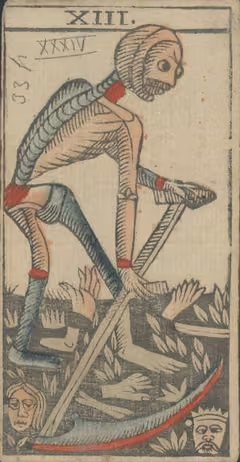
In the Tarot de Marseille, card 13 carries no name, only its number. The medieval card makers left this arcanum unnamed, without naming the skeleton that mows.
What the Marseille image shows
A skeleton armed with a scythe cuts off human limbs that rise out of the ground. The scene looks violent. Yet it represents a process of transformation, not a destruction with no return. The scythe separates and cuts away what can no longer be kept. It removes what prevents life from carrying on its work, and it does not destroy for the sake of destroying. The heads, which stand for the conceptions of the mind, become lasting once they are realized, which the heads and feet show.
What Death means
This card marks a passage: what is cut is not lost, it enters another becoming. Death is part of life. Where one form disappears, another can appear. What exists changes its aspect without ever being annihilated. By dissolving worn-out forms, Death frees energies that enter new combinations, and without it everything would languish. The living moves forward in cycles of dissolution and rebirth. The card shows the exact moment when you give up your old masks and let the transformation happen.
Its place in the sequence of cards
After the Hanged Man, who stands for voluntary stillness and a reversal of outlook, card 13 enters a more radical transformation, where something must end so that something else can come. What still clung to the old state must be given up: illusions, attachments, habits, mental structures or ways of being that prevent you from growing. In the 15th century, the image comes from the danses macabres, which reminded people that death reaches kings, bishops, merchants and peasants in the same way. The Tarot keeps this heritage and gives it a more inward meaning, that of a necessary stage on the path. The skeleton is what remains when the flesh has gone: it lasts long enough to evoke eternity, which outlasts what passes.
The Waite-Smith image
Between two pillars on the horizon, the sun of immortality shines. A king, a child and a young girl fall before him, and a prelate with joined hands awaits his end. This image shows the passage from the lowest to the highest, through change and transformation.
The four figures show four ways of reacting to change. The king, struck down, stands for the rigid ego: when life arrives with enough force, he can collapse for lack of having learned to adapt. The priest stays standing and looks Death in the face, supported by his stiff garments and his beliefs, which help him get past his fear. The young girl stands for partial innocence: she is not rigid, but she refuses to surrender, so she kneels and looks away. Only the child, who stands for complete innocence, faces Death and simply offers flowers.
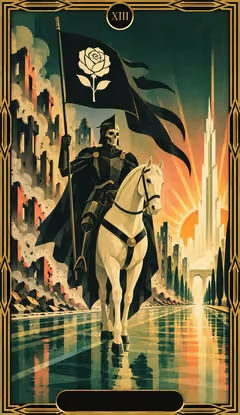
The black armor recalls that black is both the source of life and its end: it absorbs all colors as death absorbs all lives. The white horse symbolizes purity, but also nothingness. The white rose stands for purified desires: when the ego dies, selfish and compulsive needs die with it. The sun rising between the two pillars shows that, through the death of the old self, you feel the radiant power of life. The landscape in front of the pillars evokes the land of the dead described in all mythologies: you fear the death of your old self because you do not know what comes after. The river crossing the card joins change and eternity, and the boat stands for the true self carried through death toward a new life.
The skeleton and the seed
The skeleton is the structure that supports all the body's movements, and so the foundation of all growth. A seed is drawn at the upper left of the card. The same power gives life and dissolves bodies: there are not two opposed forces, but a single one that takes two forms. The rising sun in the background announces the start of a new cycle.
The number 13
The number 13 is thought to bring bad luck because it goes beyond 12, a perfect number that divides in several ways. The number 13 divides only by 1 and by itself. It breaks that perfection and announces a new creation: death undoes old forms and makes room for the new. A year has about 13 lunar cycles, and the Moon goes through its own death and rebirth every month. The 13 adds up to 4, the Emperor: through Death, you move beyond your social self. Because 13 is also a higher form of 3, the card recalls the Empress and the idea that, in nature, life and death cannot be separated.
What the card indicates in a spread
It means a time of change, and often fear of change. In its most favorable sense, it shows the clearing away of old habits and rigidity to let a new life appear. It can bring relief, sometimes mixed with sorrow, and it sometimes asks for a time of mourning. It can also mark the end of a project, a job or friendships you have outgrown. In the reverse sense, it shows you staying stuck in old habits: inertia, sleep, weariness, with a boredom that hides a refusal to change.
What holds you back
- You may fear change and cling to your old habits.
- You fear that if you give up your way of being, nothing of you will be left, and this fear can keep you in place for a long time.
- Your ego refuses the idea of dying: it keeps its energy for itself, and new energy cannot come in.
- You may let boredom and weariness win you over, which sometimes hide deep fears.
What helps
- Identify who you really are and which habits or fears you want to leave.
- Strip away everything that is not essential, to find what truly supports you.
- Let go of your personal will and of forms that have become useless, without rushing through the mourning.
- Break with ideas that are dear to you but limit your thinking.
- Imagine new ways of living: the new image comes before the new structure.