The Fool upright
The Fool is the only card without a number. It sits before all the others, at the start of the cycle, and it can also mark the new beginning after the last card. It speaks of a departure: you are at a starting point in your life and you set out light, sometimes knowing little and with hardly any preparation. This departure comes from a deep feeling more than from a carefully calculated plan. It often begins with a break with your certainties, with social order, with intellectual comfort, sometimes with the image you had of yourself. You look at what surrounds you with fresh eyes, free of weariness and prejudice. You are not yet at peace or unified: you set out while your instinctive side holds you back and some of your forces contradict one another.
The card speaks of courage and optimism, and invites you to have faith in yourself and in life. When the people around you press you to be practical, it reminds you that your own inner voice is best placed to tell you what to do. It appears at every difficult passage and encourages you to keep going in spite of fear; without this momentum, you would risk stopping at what you have already reached. You act with ardor and movement, sometimes without thinking, and you mix imagination with instinct.
You challenge the established order through sidestepping rather than direct confrontation, and you freely say what others don't dare to say.
On the spiritual level, the card speaks of ideas, thought and the wish to rise above the mundane. On the material level, when badly placed, it speaks of extravagance, eccentricity and rash actions. Its essential point is an original, subtle and sudden impulse that comes from an unexpected side. These impulses are right if you receive them well: whether the card brings you good or bad depends on your attitude.
You never reach the limit of your possibilities: you can always take one more step, and after a dead end you can step back a little, to a place from which it is possible to move forward. With no fixed goal, you can neither lose your way nor fail.
Your strengths
You are spontaneous, enthusiastic and free, and you have a child's joy. You are open to novelty and you have imagination and whimsy. You have courage and optimism, and you trust life. You are available: you know little, but you dare to learn. You carry on your way without letting the world's resistance stop you. You travel light, with only what you need. Your memories and past experiences don't steer you the way they often steer people.
What holds you back
- You lack assertiveness and follow-through with ideas: your impulses and whims don't always carry through to the end.
- You may chase an eccentric whim, set your responsibilities aside and let your instincts lead you.
- You may take foolish risks, and you may come across as irrational, gullible or scatterbrained.
- You may sow disorder through confusion and irresponsibility.
- You sometimes launch in without knowledge or reflection.
- You have your head in the clouds: you project yourself so far into the future that you lose sight of your present situation, and you expose yourself to serious dangers.
- Your spontaneity comes with insufficient judgment, and you may reveal without meaning to what should have been kept to yourself.
- You sometimes feel without aim or bearings, pushed around by others or at their mercy.
- You are passive and impulsive, you give in to your instincts and passions, and you find it hard to steer yourself and resist the influences you are under.
- You show nonchalance and indifference, and you find it hard to admit your faults.
- In trying to go beyond the limits of the real, you risk rambling.
What helps
Listen to your inner voice rather than relying only on your plans and other people's practical advice. Stay in the present and keep that fresh eye. Keep your dreams and ideals, in their place, without losing sight of where you stand. Welcome the impulses that come to you. Take the big gambles at the right time: there are moments when caution is needed, and others when it is better to do nothing. Listen to your instinctive side rather than denying it, because it grows harder when you refuse it. Accept that mastery of this instinctive side comes later, through integration and not suppression. When you are in a dark mood, don't try to push it down: look at the image of the Fool or think of it, and it lifts your spirits.
The Fool reversed
The reversed Fool is about how you take risks. You may avoid taking any, or on the contrary take them excessively and recklessly. It can also tell you to be careful, or that it is time to grow up and take on adult responsibilities. It holds back or refuses your freedom of spirit. Perhaps your life lacks adventure, or you resist chances to travel.
You may not want to look like a fool, and that makes you too anxious not to do anything stupid. You may distrust a situation, rightly or not. By sticking to what is classic and safe, you mistake limits for absolutes, or you cannot trust the future. You can also be lazy and apathetic. Not knowing where to start, you feel restless, adrift and pushed aside by others. You may feel abandoned by spirit or full of regrets, and your remorse and attempts to make amends are not always taken seriously by others.
You may be missing a warning, not following your instinct, or being careless and indiscreet. You may try to cover yourself so you are not caught out or to hide a mistake. You may pursue a futile venture that wastes your time and gives nothing back. You may do everything you can to avoid any chance of embarrassment. If you project this card onto others, you see them as innocent but irresponsible, trusting but scatterbrained, unable to grow up; their absurd antics annoy you and you would not trust them. The card can also mark a sudden change of mind about people or ideas you used to find stupid.
Psychologically, it represents your inner child: when you do not acknowledge it, it shows up at the wrong moment; when you do, it lets you play with situations and stay open to possibilities.
What holds you back
- You avoid all risk, or you take risks excessively and recklessly.
- You are careless, distracted and sometimes indiscreet, and you miss a warning.
- You make poor decisions and you hesitate.
- You feel exhausted, apathetic, abandoned or full of regret.
What helps
- Reconsidering the decisions open to you and looking at other options.
- Acknowledging your inner child so you can play with situations and stay open.
- Trusting spirit with innocence, finding wonder in everyday things, and entering a path of initiation whose end you cannot see.
What the card shows
What the image shows
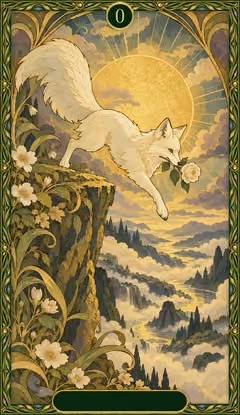
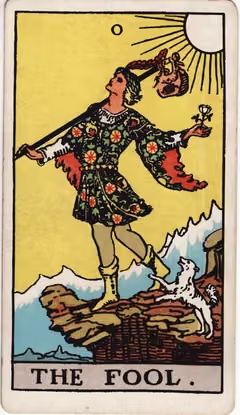
A young man in rich clothes stops at the edge of a precipice, at the top of great heights. He looks at the blue expanse of sky ahead of him rather than at the void beneath his feet, and the edge does not frighten him. His step is light, as if the earth barely holds him, and his face is full of intelligence and expectation. The sun shines behind him, and a dog leaps at his side. He holds a rose in one hand and a staff in the other, with an embroidered bag hanging from his shoulder. He represents the spirit in search of experience.
The dog
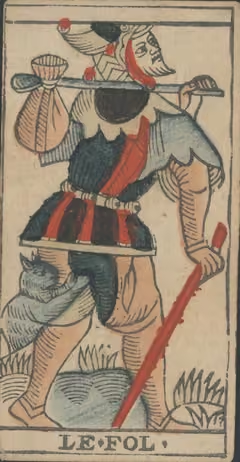
In nearly all decks, the Fool walks with an animal companion: a dog, a cat or a crocodile, depending on the deck. This animal stands for the forces of nature and the animal side of human beings, in harmony with the spirit that acts on instinct. If you deny your inner world, it turns fierce; if you listen to it, it turns gentle. In the Tarot de Marseille, the dog bites the clothing at thigh level. This has been read as instinct that holds you back, as society turning on the one who steps out of line, or as dark forces trying to pull you off your path. The Fool does not turn around, does not strike the animal and does not change his pace. The bite is a reminder that you start moving forward before you are at peace with yourself: the instinctive part pulls and holds you back, and it is not suppressed but integrated later.
The rose, the bag and the staff
He does not abandon them and he is not without thought, but they do not command him the way our memories and traumas often command us. The barely visible marks on the bag show that many unconscious memories are kept in the soul. The bag carries an eagle's head, a symbol of the spirit rising. The staff resting on his shoulder looks like a vagabond's, but it is a wand, a symbol of power. The Fool holds it so carelessly that you barely notice it, while the Magician and the Chariot grip theirs with awareness of their strength. In the Marseille deck, the staff is that of the traveler and the pilgrim, and the knapsack holds only the essentials: he sets out light, with no sign of power or wealth and no visible plan.
The costume
In the Marseille deck, the Fool wears a cap with bells, motley clothes in red, blue and yellow, and a short tunic: the costume of the court jester. The jester was both an outsider and protected, and could tell the sovereign what no one else dared to say. The costume therefore points to someone who questions the established order through distance and the margins rather than through confrontation. He stays outside conventions and is not a prisoner of the social system the others still belong to. He is available, and ignorance does not describe him.
The number 0
He carries the 0 because everything is possible for someone who is always ready to go in any direction. His innocence gives him an empty past and therefore a limitless future: every moment is a new start. The 0 is shaped like an egg, to say that everything comes out of it. Zero stands for the first unity, before any beginning, which cannot be felt or defined. The precipice has another reading: even at the edge, there is room for one more step. The Fool also means the journey outward, the state of the first emanation, the grace and passivity of the spirit.
Its place in the series
The Fool sits where there is a difficult transition. He opens the series, at the passage from the ordinary world of the minor cards to the world of archetypes. He also helps bridge the gaps between two rows, from the Chariot to Strength, and from Temperance to the Devil. He accompanies the cards of difficult passage such as the Moon and Death, where he pushes you to keep going despite fear. Among the minor cards, he is tied to Wands (action, drive, movement without reflection) and to Cups (imagination, instinct). In the Marseille deck, he is the traveler who goes through all the human experiences shown by the other cards, before the Magician as pure possibility and after the World as a new beginning. He is associated with Air and the letter Alef: breath, spirit, the first impulse. Facing the World, he shows innocence where the World shows wisdom. You do not return to the Fool's innocence: you reach the greater freedom of the World through effort, maturity, self-knowledge and spiritual awareness.
What the card means
The Fool stands for innocence: a total freedom and openness to life, without fear, through complete trust in life and in your instinct. This does not exclude sexuality, which is then expressed without fear, guilt or calculation. The Fool expects nothing and plans nothing: he responds to the present situation, and gives his honesty and his love naturally to everyone, without thinking about it. In a spread, he speaks of courage, optimism and faith in yourself and in life. When others push you to be practical, he reminds you that your inner self knows best what you should do. He can symbolize a beginning: a leap into a new phase, taken on a deep feeling rather than on a plan. He can also mean an original, subtle and sudden impulse, coming from an unexpected direction; it is right if you receive it well, and the meaning of the card depends on your attitude.
The fragile side of the image
At first glance, the Fool is someone looking at the sky who is about to fall from a great height. The first lesson is not to project yourself so far into the future that you lose sight of where you are. Dreams, visions and ideals have their place, but anyone who gets lost in unreal things makes themselves unfit for practical matters. In the common sense, the card speaks of thoughtlessness, extravagance or eccentricity. In the Marseille deck, it is tied to inattention, disorder, careless promises and insecurity.
Your strengths
Spontaneity, honesty and love given without calculation. Trust in your instinct. Availability and freedom from conventions. The ability to start over: every moment is a new start.
What holds you back
- You do not follow your instincts, out of fear or because you depend too much on other people's plans and practical advice, and you let an important chance pass.
- You act recklessly or through wild schemes. This comes from the same weakness: you do not trust your inner self to guide you, and you are afraid of doing nothing.
- You have your head in the clouds and lose sight of your present situation.
What helps
- Know that big risks are taken at the right moment: there are also times when caution, or doing nothing, is better.
- Listen to your instinct and your inner self when you are pressed to be practical.
- Accept that your instinctive side pulls and holds you back: it cannot be suppressed, it is integrated over time.
- Look at the image when you are in a dark mood, without trying to suppress that mood: it gives a positive impulse.
- Receive a sudden impulse with the right attitude, because that is what decides its meaning.