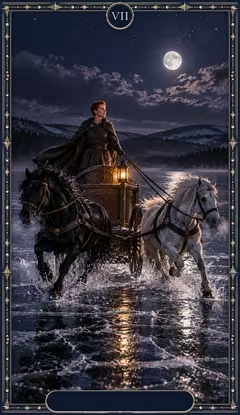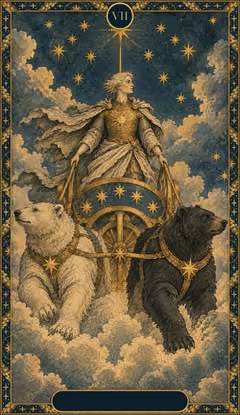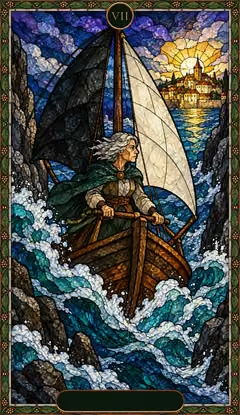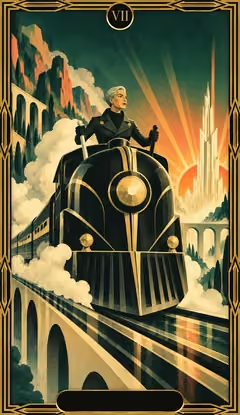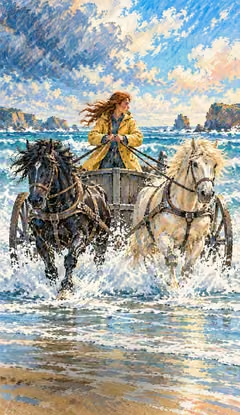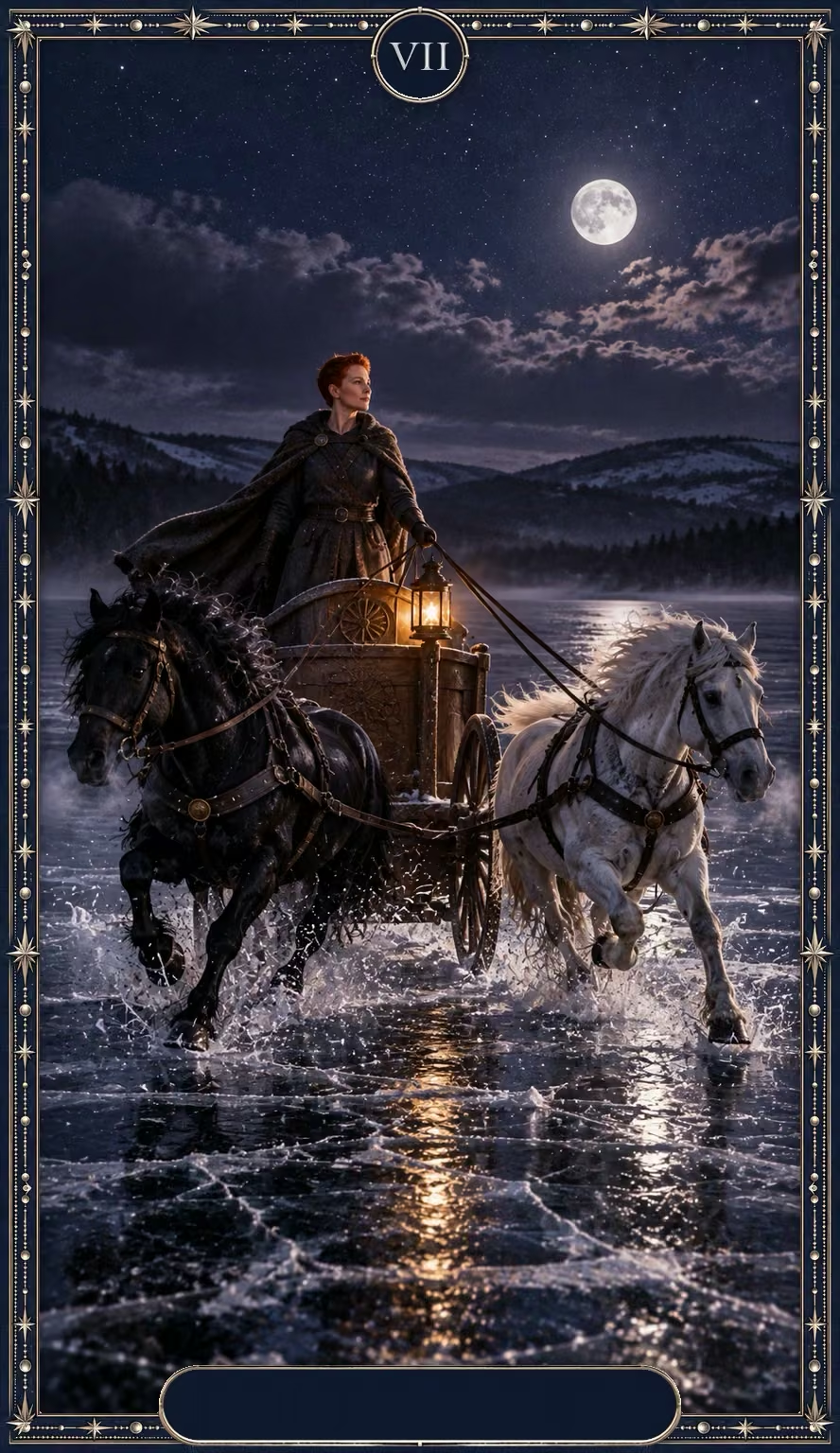
The Chariot upright
The Chariot is the card of victory, triumph and mastery. It shows that you are driven to win, to prove your worth and to get a grip on the conditions of your life. You set a goal, sharpen your skills and focus your efforts on reaching it: career, recognition, influence. It comes right after the Lovers, the trial of choice. It shows the mastery you gain once the decision is made: after scattering comes cohesion, and this is your first victory over yourself. This progress is inner first, before it becomes visible.
You hold together forces that pull in opposite directions: attraction and rejection, desire and fear, drive and restraint. You do not suppress them, you steer them. Your victory does not come from the tensions disappearing, it comes from bringing them into agreement. Energies that would cancel each other out on their own become useful once you harness them together. Even the force that grows impatient and pulls its own way carries you faster, because it makes the other pull harder. Your character is enough to hold these opposing forces.
This mastery reaches the four areas of your person: will, thought, feeling and stability. You no longer submit to your impulses or your unconscious images; you have become aware of them and you put them in order. You control your instinctive desires and your sex life, which then contributes to a satisfying life. You are not the victim of your emotions. At first glance, this gives you the bearing of a mature adult: successful in life, admired by others, confident and at ease with yourself, able to control your feelings and direct your will. Your will weighs more than the rules of society, but you do not rebel against them. Your professional bearing serves as armor and gives you a role that displays your seriousness. That role also hides your vulnerability.
The Chariot shows success won by merit, not by luck or favor. You lead with an awareness of the ups and downs of the human heart. You look ahead and to the sides as well, because you cannot steer through life with too narrow a view. You try to reconcile opposing opinions, help adversaries understand one another and put an end to quarrels. You insist on fairness in the smallest acts, out of consideration for others, and on a demanding standard of courtesy.
The Chariot also signifies protection and providential help. It carries hope and memory, obedience, loyalty and an authority that remains subject to another authority. Its victory plays out mostly in the mind, in science and progress. You may also have to deal with travel and transport. The card tests your maturity in your search for yourself.
It calls for an attitude of receptivity. The barriers that separate you from others are largely artificial: they come from the upbringing and habits your parents and elders imposed on you. The will you feel within you works through you more than it originates in you.
Your strengths
- You have willpower and you direct your energies toward a goal.
- You have self-mastery: your feelings, instincts and desires stay under your control.
- You know how to command obedience and to govern different forces.
- You reconcile opposing views, and you are fair and polite.
What holds you back
- You can get carried away by your success and identify with it, to the point of being sick with triumph.
- You can be presumptuous, proud and arrogant.
- You become rigid when you subject everything to your will, and you cut yourself off from the forces you have learned to master.
- You control your opposing forces without reconciling them. If your will weakens, everything can fall apart.
- You can mistake your successful persona for your true self, to the point of fearing its loss like a death.
- You understand outer life well without knowing yourself.
- Your victory stays external and logical: you can remain a prisoner of your own reasoning, with no answer when something touches the inner life.
- You can shut yourself in words. By relying too much on what can be said and measured, you push aside what cannot be explained.
- You can defend traditional ideas with violence and harshness, even to the point of wanting to destroy.
What helps
- Taking life seriously, steering your two opposing forces well and staying in command of all your energies.
- Holding your tensions together rather than crushing them.
- Recognizing your illusions, which lets you move forward with consistency.
- Keeping the right distance between yourself and what is bigger than you, without taking yourself for the absolute.
- Accepting the limits of life and your human nature, with its strengths and weaknesses.
- Staying receptive and undoing the barriers you learned in childhood.
The Chariot reversed
The upright Chariot is about mastery and success: you steer a situation through the strength of your personality. Reversed, it shows that willpower alone is no longer enough. You may be on a path of self-discovery, working to overcome obstacles on the way to victory, and the card asks what price you are paying to move forward. The Chariot is also the figure of a young champion setting out on the road to mastery; reversed, it shows someone at risk of a fall. You may be overconfident in your attitude and hasty in your actions. It is easy for you to wander off your course.
Your situation holds contradictions that have not been brought together. They are only kept under control, and reversed, they gain strength. You may face conflicts and difficulties because ideas and goals oppose each other. Faced with opposition, or lacking experience, you may hesitate, or on the contrary act without thinking. You may also be carried away by an idea that slips out of your hands, or go in circles instead of moving toward your goal. Your energy scatters or overflows without control.
The card can also describe you as someone who is inconsiderate and does not respect other people's rights. It can point to anger and agitation, sometimes violence. In a competition, you may lose through lack of energy, stamina or skill, or on the contrary be too aggressive and play unfairly. The risk is an inflated ego and the conviction that any means is fine for reaching your goal.
Seen in someone else, the card makes you perceive that person as a tyrant, an outlaw or a rebel. You may also idealize them as the conquering hero, the one who knows how to fix everything. For a woman, it can mean she is losing the prestige she thought she had built in a man's world, that she is letting go of the reins and being sent home. She then waits to be rescued because she believes she cannot do it herself.
What holds you back
- You are overconfident and act in haste.
- You rely only on your willpower, when it cannot always support you.
- You hesitate or rush in without thinking, because of inexperience or in the face of opposition.
- You scatter your energy, or it overflows without control.
- You can be aggressive, have an inflated ego and disregard other people's rights.
- You let yourself be pulled off your course.
What helps
- Finding an approach to your difficulties other than willpower alone.
- Accepting that sometimes it is better to yield than to force.
- Choosing not to be in the foreground and working behind the scenes.
- Focusing your energy close to home or on an inner path rather than setting off.
What the card shows
What the image shows
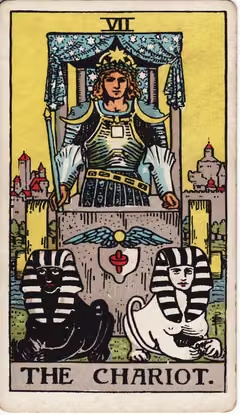
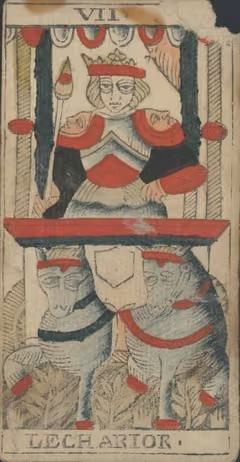
A crowned young man stands upright on a chariot. He is carried more than he drives: his hands hold no reins. A canopy decorated with stars, held up by columns, covers him. In the Tarot de Marseille, the chariot is drawn by two horses, often of different colors. Behind him are a city surrounded by a stone wall and a river. The wheels of the chariot rest on water. The chariot is motionless. The driver wears armor that mostly protects his chest, and a crescent moon on each shoulder. An eight-pointed star decorates his crown, a bright square shines on his chest, and magic signs cover his skirt and belt. A cloth hangs behind the chariot, like a veil.
A victory won after a choice
In the sequence of cards, the Chariot comes after the Lovers, that is, after the choice: it shows the mastery gained once the decision is made. It is a first victory over yourself, which begins inside before it shows on the outside. The number 7 also carries the meaning of victory. It stands for the developed ego: the mature adult, who succeeds, who is admired, who is sure of herself, who controls her feelings and directs her will.
The two horses or the two sphinxes
They nonetheless look in opposite directions, and only the driver's will keeps them in tense balance. If this will gives way, the team tears apart. The horses or sphinxes also stand for instincts and desires, which the driver keeps under control. The sphinx poses a riddle to whoever passes: if you do not understand your own humanity, with its strengths and limits, life puts you in difficulty. In the Waite-Smith tarot, the driver has answered this riddle, but his victory is over outer domains: mind, science, progress. It can leave him a prisoner of logic, and he does not know how to answer the High Priestess's questions. The myth of Oedipus says the same thing: he understands man in general, but he does not know himself.
The elements of mastery
The driver is master of fire, will, of air, thought, of water, sensitivity, and of earth, stability. He no longer endures his impulses or his unconscious images: he has become aware of them and puts them in order. The Conqueror is at the center of the four elements: the cubic chariot, the three pentagrams of his crown and the four columns say that he has conquered and directed the elemental forces. The two sphinxes stand for the active principle and the passive principle.
The canopy, the chariot and the city
The chariot is larger than the city behind it: his will weighs more than the rules of society. Since he does not move, he does not rebel. The walls that separate you from others are largely artificial: they come from the upbringing and habits received from parents and adults. The river enters the image and leaves it: the willpower you feel in yourself passes through you rather than being born in you.
The other cards found in the image
The wand and the magic signs recall the Magician, the water, the sphinxes and the veil recall the High Priestess, the stars of the canopy recall the Empress, the city recalls the Emperor, the shoulder plates recall the Hierophant, and the symbol placed in front of the chariot recalls the Lovers. The Chariot thus gathers everything the earlier cards have built: it is the outer personality. It crowns a first series of cards, but it does not yet touch the deep unconscious.
The driver wears amber armor and a crab as his crest, and his visor is lowered. He is set in the chariot rather than driving it, because the whole system of advance is in balance. He carries the Grail, placed at the center of the card. The canopy is midnight blue, and the chariot is drawn by four sphinxes, mixing the bull, the lion, the eagle and the man.
What the card is trying to say
It speaks of triumph, mastery and progress, but also of an ego that must keep instincts and emotions under control. The armor of success is also a mask that hides vulnerability. The driver can be sick with triumph, identifying with his success, or integrated, having gone through the ordeal of choice and moving forward with coherence.
Your strengths
You direct your will and you control your feelings and desires. You move forward after choosing, with coherence. You are able to lead your career and gain mastery.
What holds you back
- You risk identifying with your success to the point of being sick with triumph.
- You can become rigid, cut off from the forces you have learned to control, if you subject everything to your will alone.
- You risk confusing your successful persona with your true self, to the point of fearing the loss of this mask as a death.
- You control your opposing forces without reconciling them, and they tear apart if your will weakens.
- You may reduce experience to words and logic, and reject what cannot be measured.
- You can understand others and the world without knowing yourself.
- You can feel torn between several needs and desires, and the armor you wear hides your vulnerability.
What helps
Keep the right distance from what is larger than you, without getting lost in it. Accept the limits of life and understand your own humanity. Become aware of your unconscious images and your impulses. Look to know yourself after succeeding on the outside.