The Emperor upright
The Emperor is the card of order, stability and protection. It is linked to the sign of Aries: the strength and initial drive, put to work in a structure that holds.
In your situation, it shows that the task is to set rules, draw limits, name and define things, and analyze what falls within your domain. You may be building, acting, organizing or administering, giving a solid form to what your feelings and imagination have brought to life. The situation gives you the chance to act with strength and conviction. You can take the lead, gain power or accept responsibility, set yourself goals and express your vision within a hierarchical framework.
This card speaks of your relationship to power, law and order. It asks you to take back your authority, or to see where you have handed it to someone else. It also stands for the rules of society and the power to enforce them, for better or for worse. A fair society lets everyone pursue their needs and their growth, but unfair rules hold that growth back.
The deeper meaning of the card is an authority that does not try to impose itself. It is exercised as a responsibility and not as a privilege, it serves a law greater than itself, and it leaves room for others to stand and grow. It also stands for the act of sorting and ordering your ideas in order to master your surroundings. This control does not mean imposing your ideas on the world: you must see things as they are and reason from accurate observation.
This card represents the father, fatherhood and authority. It can point to the inner father, the one who approves or disapproves of what you do and who sets what is expected of you. It can point to a person who has a great deal of power over you, through strength or emotionally: often your father, sometimes a husband or partner to whom you leave control of your life. When you stay stuck at the level of this card, it is often because you have never accepted your father's ordinary humanity: you may recognize it with your reason, but it still disturbs you.
Your strengths
You have a taste for facts and reasoning: you like to analyze and measure. You know how to defend your territory, set firm limits and maintain them. You know how to provide stability and protection for those who depend on you. You have mastery, knowledge and expertise, and you can take the lead of a group.
What holds you back
- You value analysis and measurement more than emotion and intuition.
- If you lose touch with your passions, your life becomes cold and barren.
- You surround yourself with armor against attacks, chance and the emotions that disturb you.
- You are overconfident, quarrel easily, and are reckless, bad-tempered and impractical.
- You may struggle to go beyond the rules you were taught.
What helps
- Setting clear limits and sticking to them.
- Setting yourself goals and giving your vision a structure.
- Seeing things as they are and defining from the facts.
- Exercising your authority as a responsibility, without crushing others.
- Absorbing the rules of your background and its traditions, then going beyond them to find your own code of conduct.
- Not breaking rules on principle: the woman who always breaks them stays as tied to them as the one who follows them without thinking.
Careers
chief, senior executive, manager, administrative or decision-making post, government, army.
The Emperor reversed
The Emperor represents the father, authority, law, order and the limits you set. Reversed, he shows authority that is poorly lived, in you or in someone around you.
This authority can be tyrannical and overconfident. It can also take the opposite form: a lack of strength, will and courage. Most often the situation lies between the two: a father, boss or leader betrays your trust, withdraws support, fails to protect you or fails to defend his principles. This can point to an absent or ineffective father, or a leader who has failed. The card also speaks of false pride, and of a sudden humiliation that overturns what you thought was solid.
In yourself, you may hesitate, back away from a challenge, lose control or use excessive force. Instead of setting limits, you build walls and obstacles. Instead of strengthening your resolve, you freeze into rigidity. You may rely too much on what you call reason and facts, leaving no room for other opinions. You can be overly critical and too harsh in your judgments, overconfident, competitive or paternalistic. The card also describes the person who uses power, or physical or intellectual superiority, to dominate others.
If you have handed your authority to someone else, your self-confidence and self-esteem suffer.
You may also have rejected certain traits associated with the masculine, or stepped outside traditional models to invent other ways of expressing yourself. You may be missing, at the moment, a relationship with a man.
The card also refers to the father and the authority you have internalized. This inner voice can disapprove of you and censor you, or guide you wisely in the ways of the world.
You may have seen in one person the ideal of mastery, then come to see them as a tyrant or as weak, as someone who abuses or is abused. This person can also be an adversary. An old role model may have fallen from his throne.
The traditional meanings of the reversed card are opposition, obstruction, stoppage and stubbornness, immaturity, ineffectiveness and indecision, prejudice, tyranny, a weak character, abuse of power and failure. It also includes protection, benevolence, compassion and goodwill.
What holds you back
- You hesitate, back away from a challenge or lose control.
- You freeze into rigidity instead of setting clear limits.
- You trust too much in reason and facts, and you leave little room for other views.
- You are too critical, too harsh in your judgments.
- You have given your authority to someone else, and your self-confidence suffers.
- You feel disapproved of and censored by an inner voice.
What helps
Notice to whom you have given your authority and take it back.
What the card shows
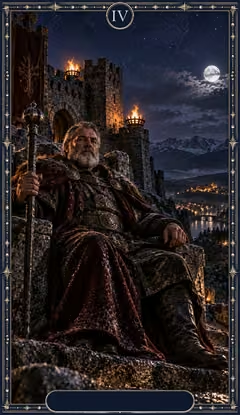
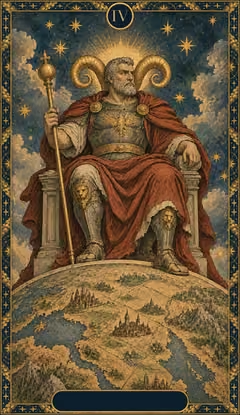
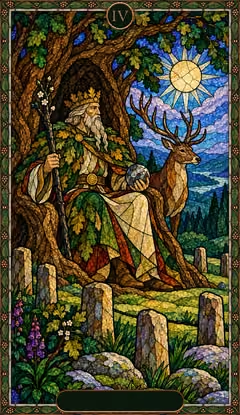
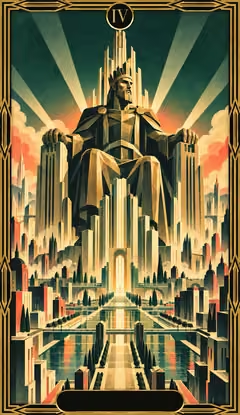
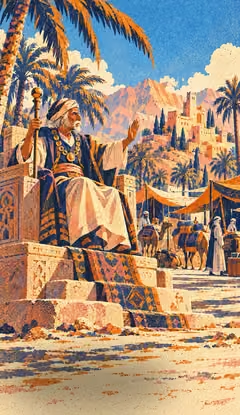
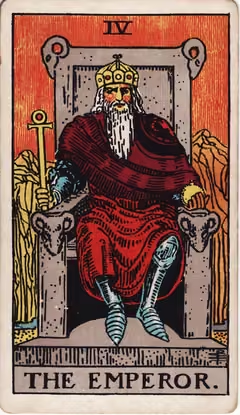
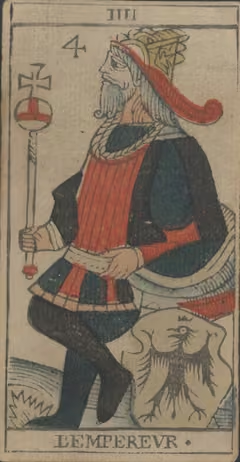
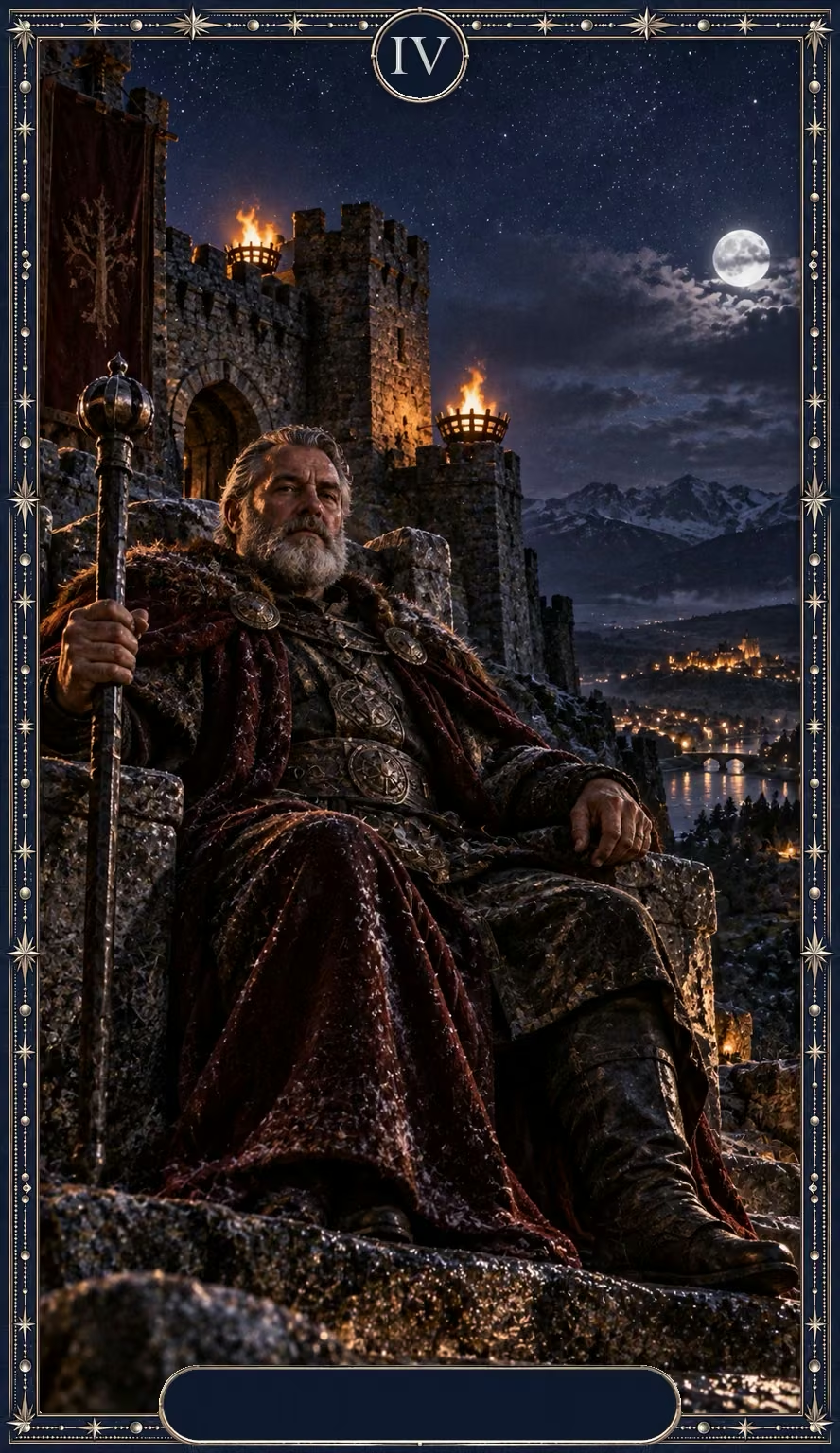
The Emperor is a crowned sovereign, seated on a throne, in the clothing and insignia of a king. He holds a scepter and, in his left hand, a globe; the scepter is shaped like an ankh, the Egyptian symbol of life. In the Tarot de Marseille, he sits steadily, often in profile, with his legs crossed, with a scepter and one arm resting on a shield marked with the eagle.
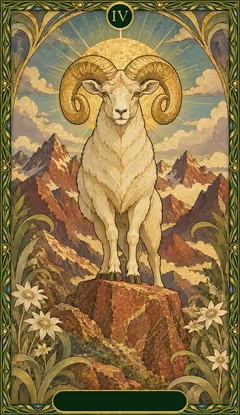
The throne carries ram heads: the ram is the animal of the sign of Aries, to which the card is tied. Aries is the first sign of the zodiac. It evokes strength, aggression and war, but also the new life of spring, which can be born from the stability of a just society. The ram is a wild and courageous animal, alone in solitary places. Tamed, it becomes docile and gregarious; the image thus illustrates how a government works. This sign joins energy in its most material form with the idea of authority.
His arms and head draw a triangle, his crossed legs draw a cross: together, it is the alchemical sign of sulfur, that is, of fire. Sulfur stands for masculine energy, quick and creative, the initiative of everything that exists.
The throne is a cube in some versions. A cube is stable by its shape, and it stands for the solid order on which everything is built. A cube has twelve edges, six faces, three axes and one center, which makes twenty-two, the number of the major cards, the Hebrew letters and the paths of the Tree of Life; it therefore stands for the world.
The shield shows an eagle. It is a red, two-headed eagle, which corresponds to the solar principle and to gold; the Empress's white eagle corresponds to the Moon and to silver. He also wears armor whose breastplate shows the Sun and the Moon: reason and imagination light his action. The dominant red of his costume stands for the fire he directs to give life, and the green of the sleeves suits arms that act. A tulip opens at his feet. A braided crown or collar signals order, methodical sequence and solidity: the commitments he makes are kept.
The Emperor stands for the laws of society, good or bad, and the power that enforces them. At best, he shows the stability of a just society, which lets its members pursue their needs and develop. Without structure, everyone would spend their life struggling to survive. At worst, stability comes before morality and unjust laws are imposed. Even at his best, he remains limited: he puts a network of rules over the Empress's spontaneity, and a life governed too rigidly becomes cold and sterile.
He stands for authority more than power. Power imposes; authority comes from one who steps back behind a law greater than himself. He holds his office as a responsibility rather than a privilege. Solid authority does not rest on violence: it creates a space where something can stand and develop fairly. He also stands for a living hierarchy, which keeps the whole coherent. He acts from the real: he does not flee matter, he gives it form and stability.
He carries out the idea on earth, relying on a plan and on a protection that keeps out troublesome interventions. He is also kingship of thought, not only of the material world. He is concrete, executive and realizing power.
The card stands for the order the mind puts into what it sees. Classifying, telling one thing from another, is the basis of control over your surroundings. This control requires seeing things as they are: definitions must fit the facts and reasoning must follow exact observation. Sight is the sense associated with it.
This energy of Aries is sudden, lively, but short-lived. If it goes on too long, it burns and destroys. His authority is described as coming from a creative wisdom and is exercised over the organized human being.
Personally, the Emperor shows the ability to make laws, set limits, name and define things, analyze your domain. He points to someone who builds, directs or administers, who has expertise, leadership and a sense of responsibility. He can mean a period of stability and order, which leaves room for creative energy. He shows the ability to defend your territory, draw clear limits and maintain them. He stands for a rational approach that values analysis and measurement more than emotion and intuition. Your reaction to this card tells your relationship to power, law and order.
The card can point to a person who has great power over you, objective or emotional: often the father, but also a husband or partner. It can also point to the inner father, the one who approves or disapproves of what you do. When you have never accepted your father's ordinary humanity, you stay stuck at the level of this card.
What the card means
After the Empress who makes things grow, the Emperor fixes, supports and orders. The question is no longer expansion but holding. The two cards stand for the parents in their role as founding figures: the Empress the natural world, the Emperor the social world.
Your strengths
Reason, logic and an analytical mind. The ability to set limits, define and organize. A sense of order and method.
What holds you back
- You can become rigid and freeze your position, instead of simply setting a framework.
- You rely too much on reason and facts, without leaving room for other opinions.
- You become critical, self-assured, paternalistic or domineering.
- You put up walls rather than limits.
- You are prone to obstinacy, hot temper, rashness, overconfidence and irritability.
- When you give your authority to someone else, your confidence and self-worth suffer.
- You may hesitate, back away from a challenge or lose control.
- You may let yourself be dominated by a person who has great power over you.
What helps
- Absorb the rules, traditions and beliefs of society, then go beyond them to find a personal code of conduct. Breaking every rule on principle leaves you as tied to them as following them blindly.
- Take your authority as a responsibility and not as a privilege.
- See things as they are: define precisely and reason from exact observation.
- Recognize where you have given away your authority, and to whom, and take it back.
- Set goals for yourself to steer your future within a structured framework.