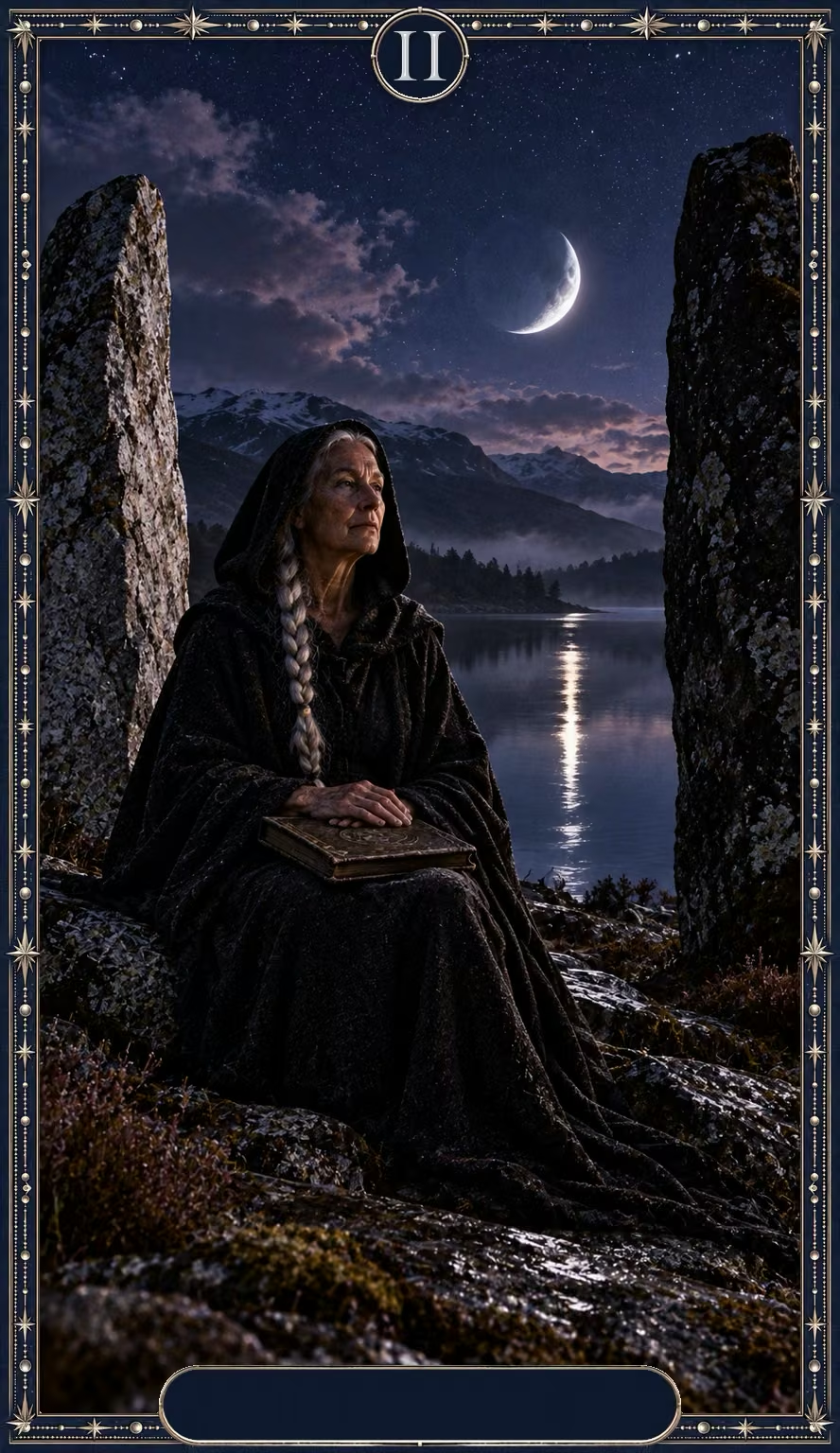
The High Priestess upright
The High Priestess, also called the Papess, speaks of the mystery in your life: what you don't know and what you cannot know. She indicates a period of passive withdrawal, which can be a time of fear but also of beauty, and which enriches you by letting what is inside you awaken. She suggests spending time alone, withdrawing into solitude and following the natural rhythms of your body. You may have a correct hunch about a big question without yet being able to put it clearly into words. You may be keeping a secret or protecting your privacy. Hidden motives or unseen factors may weigh on a decision or a negotiation.
The card also describes an attitude: you may seem mysterious, calm and distant, while offering someone a listening ear and understanding. You may receive help or advice from a wise woman, a counselor or a mediator, or be an attentive listener for someone else yourself. You may feel an intuitive bond with a person. For a woman consulting the cards, this card can also stand for her own self.
The High Priestess represents the deepest inner knowledge, the kind that can't be explained in rational words: trying to explain it would limit and distort it. She shows the very strong possibilities you carry within you that you haven't yet realized, but that you sense are possible. She also represents memory: everything you live through stays recorded in you, and you can recover it by staying calm and relaxed rather than by forcing it. In the Marseille tarots, her knowledge is absorbed slowly, kept close to her and not proclaimed: it is a time of maturing before action. This silence is an availability: to wait is to stand ready and let appear what would stay hidden in the tumult.
In a spread reading, she also means that something hidden is revealed, with a feeling of security and mastery of events, and she gives meaning to the other cards.
Your strengths
You look for a deeper meaning in your life and your work, and that gives them more value.
What holds you back
- You may stay passive at the wrong moment or for too long, which weakens you and makes you afraid of life and of other people.
- You have strong intuition but can't manage to turn it into action.
- You prefer quiet retreat to the exposure that life with others requires.
- A completely passive life makes you apathetic, anxious and depressed, because the mind needs passion and a connection with the world.
- You may conceal your intentions, hold a grudge, and fall into inertia and laziness.
- You risk being carried away by enthusiasm and losing your balance if you don't maintain it.
What helps
Taking action: what you sense as possible only comes about if you act. Using passivity as a counterbalance to outward-facing action. Combining rigorous logic with great sensitivity to understand what is hidden. Seeking advice or inner guidance to choose your path, a middle path, without extremes. Bringing opposites together. Not forcing yourself to remember: stay quiet and relaxed, and what you need comes up by itself, provided you were attentive at the time. Giving yourself a time of silence before you speak or act, without trying to get everything at once.
The High Priestess reversed
The upright High Priestess speaks of inner knowing, intuition, mystery and withdrawal. When she goes wrong, even upright, she points to passivity that lasts too long or comes at the wrong time, leading to weakness and fear of life and of other people. Reversed, she shows this inner side blocked or turned around.
You may have trouble reaching your intuition, remembering your dreams or knowing what you feel. You may be cut off from your inner wisdom, or reject it. Some people are more comfortable with the reversed High Priestess than with the depths of the upright card.
This card goes to two extremes. On one side, you open up completely, hold nothing back and linger over fads and surface flirtations. On the other, you become even more formal, more serious in your manner or more closed in, and you may feel trapped. You can be self-effacing or provocative, or seething with restlessness because you lack choices.
Turning the card over also brings in what the upright High Priestess lacks: a drive toward passion and deep involvement in life and with others, emotionally, sexually and competitively. But this movement can go too far, and you then lose what is most precious: the sense of your inner world.
In your relationships, the reversed card heightens the feeling of superficiality and distance, unless it marks your return among others after a period of isolation. You may lack female company or feel betrayed by a woman. The feeling of loneliness and the lack of self-confidence generally grow, but you can also be firmly alone, by choice. If you are an inspiration or a mirror for someone, you may feel a loss of yourself and doubt your identity. Secrets are revealed or withheld, confidences are broken, and intrigues disturb your exchanges. Your calm and receptivity are disturbed. If you dare to act outside other people's expectations and refuse to be walked on, you may be called a witch.
This card also shapes how you see others. You may see them as sacred and untouchable, or on the contrary as irrational, fickle and unreliable. You may suspect them of coldness, superficiality and insincerity, or think them delicate and fragile. The High Priestess reflects your inner feminine side: what you see in the reversed card may therefore disturb you.
Your strengths
You can come out of isolation and get deeply involved in life and with others. You can also accept being alone and depending on no one. You can dare to act outside other people's expectations.
What holds you back
- You have trouble listening to your intuition, remembering your dreams and identifying what you feel.
- You swing from one extreme to the other: too open and superficial, or too formal, closed in and trapped.
- You feel alone and you doubt yourself.
- You risk losing yourself when you act as a mirror or an inspiration for someone, and doubting your identity.
- In trying to throw yourself into life, you can lose touch with your inner world.
- You project coldness, insincerity or inconstancy onto others, or you put them on a pedestal.
What helps
Taking time alone, listening to the rhythms of your body and of nature, and seeking inner counsel. Moving into action to give shape to what you sense, because this potential does not come true without it. Not shutting yourself into an entirely passive life, which leads to apathy and fear.
Love
The reversed card heightens superficiality and distance in relationships, unless it marks a return to others after isolation. It can also bring passion and seduction.
What the card shows
What the image shows
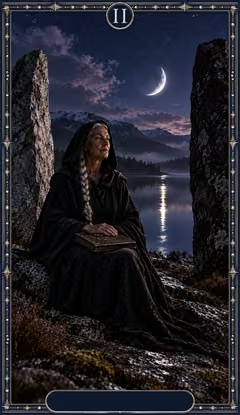
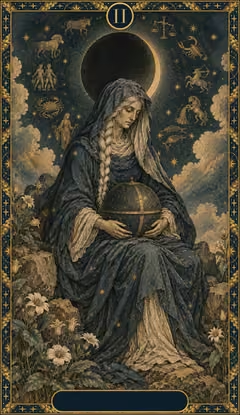
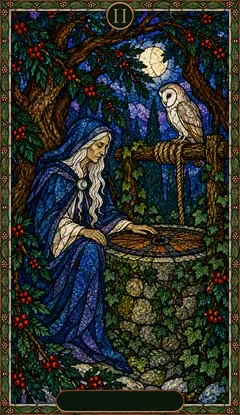
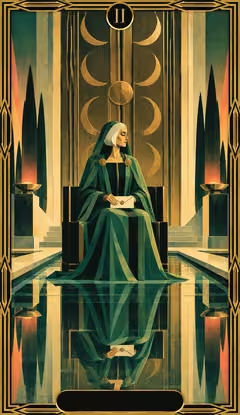
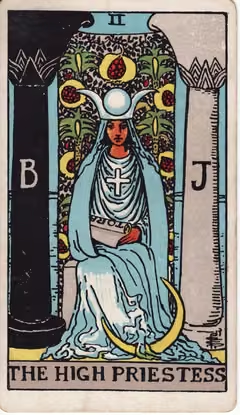
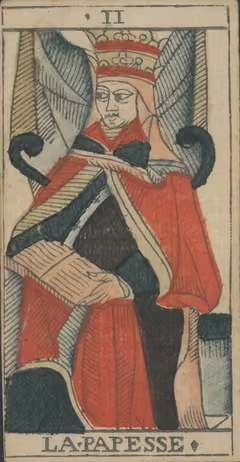
The High Priestess is a seated woman, still, calm and silent. After the Magician, who stands and acts, she marks a stop: she occupies space instead of crossing it. She wears a tiara and holds a book on her knees. She does not bless, proclaim anything or govern: she guards. Her posture is stable and almost motionless.
The book
The book stays close to her body; it is not held up toward others. In the old versions, it is closed or half open: the knowledge is not yet handed over, it is held in reserve. In another version, her right hand half opens the book of secrets, and in her left hand she holds keys that open the inside of things. One of the keys is gold and corresponds to the Sun, that is, to reason and speech. The other is silver and corresponds to the Moon, that is, to imagination and intuition. This means you have to combine rigorous logic with great sensitivity to guess what is hidden. The book or scroll she holds also says that she keeps the memories of the past. The knowledge it represents comes from slow absorption and a memory that forms over time, not from demonstration.
The two columns and the veil
She sits between two columns, at the entrance of a temple, in front of a veil that hides the sanctuary. The resemblance recalls that we naturally group similar images, and the opposition of colors recalls that we also associate opposites: thinking of light makes you think of darkness. These two columns stand for the original duality: father and mother, subject and object, activity and sensitivity. The card comes after Unity and opens the domain of two, that of distinction. The veil stands for what we perceive of appearances, and the images of thought are projected onto it. It does not mean that truth is refused. It shows that truth does not give itself whole all at once. Whoever stops at the images on the threshold lets herself be fascinated. Whoever proves worthy can read in the High Priestess's gaze and is deceived by no illusion.
The colors and the clothing
Blue dominates the card. It is the coldest color, and it contrasts with the Magician's warm red. She is dressed in dark blue, with a white stole that forms a cross on her chest. She wears a purple cloak edged with gold and lined with green. Green is the color of the vitality of living ideas. Purple corresponds to the highest aspirations, and the gold border to religions. A crescent tops her silver tiara: it shows that her teaching rests on imagination. The tiara has two diadems. The one that touches the forehead points to occult philosophy and hermeticism, and the highest to gnosis, a faith founded on knowledge. In the Tarot de Marseille, the tiara has three tiers and marks spiritual authority.
The ground, the cushion and the sphinx
Her right foot rests on a cushion, which stands for the small number of certain notions one can acquire about the mystery.
What the card means
The High Priestess represents an authority that comes neither from public proclamation nor from a visible institution. It comes from a depth kept within. Her power is that of consciousness, not that of the throne. She is the place where knowledge settles, takes structure and grows stronger, and she also points to the inner state able to receive it. She is not a figure of ignorance: she knows that not everything can be handed over right away, because not everything can be received with the same depth. She corresponds to intuition, divination, contemplative faith and discernment of the mystery. The divination she inspires serves to tell the reality hidden behind appearances. For someone with intuition, phenomena are a facade that reveals something. Her silence is an active form of availability: to wait is to stand ready, and to listen is to suspend the noise so that what would stay covered can appear. Before thought becomes speech, before an idea takes form and action unfolds, there is a time of gestation, and the High Priestess stands for that time. She teaches that truth is gathered in stillness more than it is conquered in agitation. Only from her can action stop being a mere attempt.
Memory
She stands for memory, that part of us that keeps everything we have lived, the trivial as well as the important. This memory is complete and does not improve: what you can develop is the ability to recall. It takes concentration and attention, because a memory that seems faulty often lacks attention. Forgetting is as important as remembering. The High Priestess's calm says that forcing yourself to recall blocks the memory, while staying quiet lets you see it come up easily, as long as the first impression was clear. She is calm, receptive and, as her old title says, a virgin.
Number and letter
The number 2 brings the idea of doubling, in contrast with the unity of 1. The name of the Hebrew letter that corresponds to her, Gimel, means camel and evokes travel and the carrying of news from one place to another. The 2 adds the two ends of a journey and the two people who exchange a piece of news, the one who speaks and the one who listens. She is associated with the Moon, a feminine and universal planet. She is also linked to Isis, the goddess of deep night. In a modern version of the tarot, she carries an Artemis bow and appears as the one who initiates, the one who starts the path.
The name
In the first Italian tarots of the 15th century, this figure already bears the name of Popess. Her presence in a deck of cards long caused surprise: she is a female authority in a religious world dominated by men. In Besançon, she was later replaced by Juno, who points with one hand to the sky and with the other to the earth. This points to the idea that what is above is like what is below, and that the visible serves as a symbol of the invisible: this is the starting point of the method of analogy, on which all of the High Priestess's science rests.
What holds you back
- You can fall into inertia and laziness.
What helps
- Stay calm and quiet to let a memory come back, without forcing.
- Pay attention to what is happening while it is happening, because you forget what you did not really notice.
- Consent to a time of withdrawal and silence, without forcing knowledge.
- Combine logic and imagination to guess what is hidden.
- Give what you are learning time to ripen before you say it or put it into action.