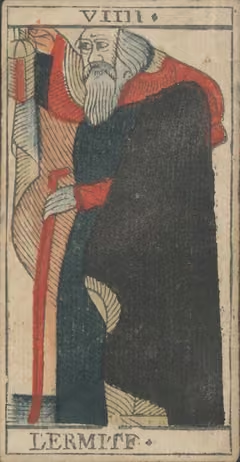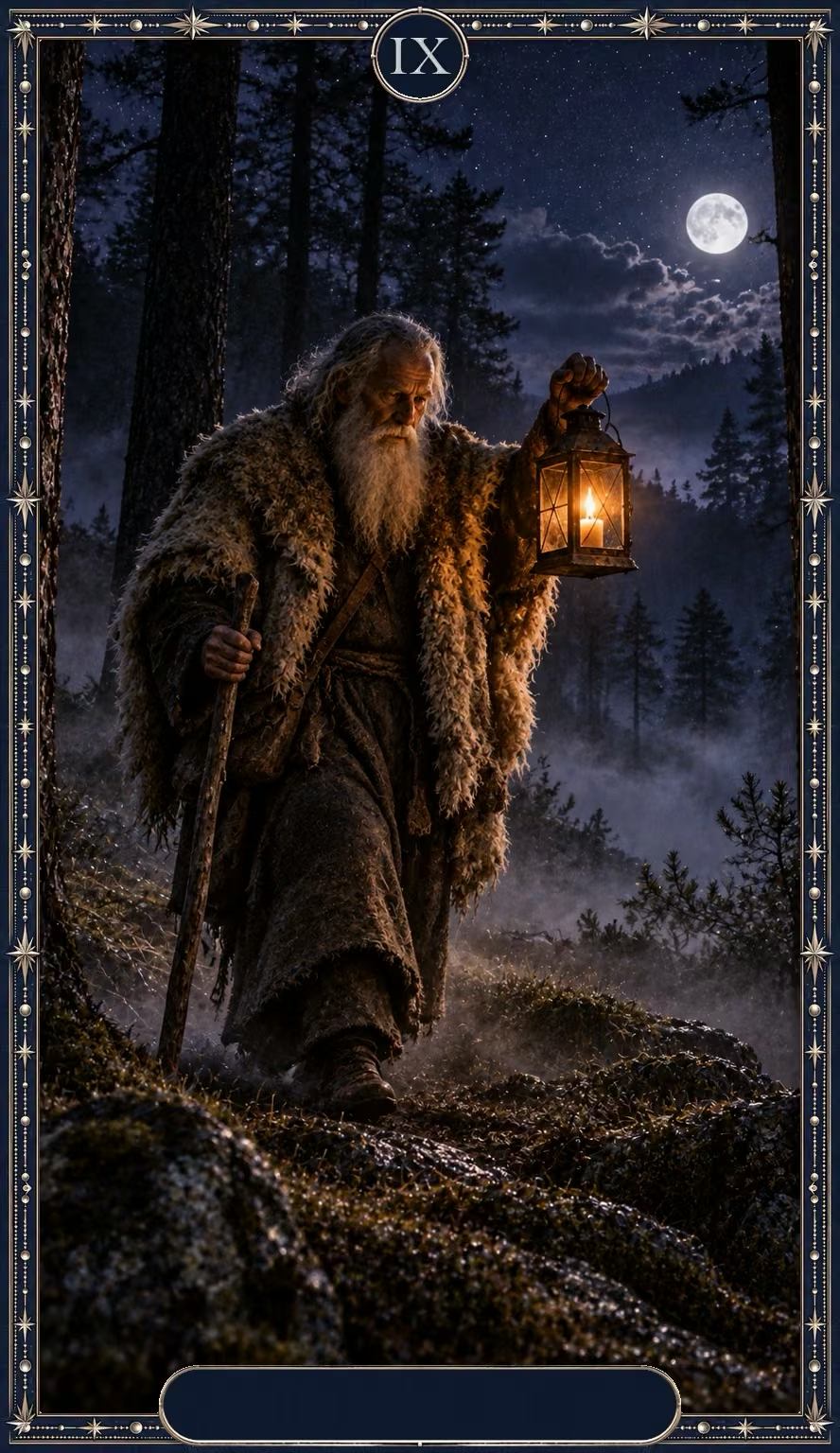
The Hermit upright
The Hermit speaks of withdrawing from the outer world to turn toward your inner life. Your attention leaves the noise of the world and the concerns you thought essential and moves toward your deep needs, and you may detach emotionally from certain people or activities. You do not withdraw without purpose: you do it to work on yourself, understand the meaning of what you are living and find what truly matters. This solitude comes from clarity and not from rejecting people. It is solitude without emotional isolation.
You move forward slowly, by the light of what you have understood, without trying to convince anyone. You need a long time to mature: reliable knowledge takes withdrawal and a sorting out of what weighs you down. You may look for truth, wisdom and knowledge outside the usual paths. You may also go back over your past to understand how it weighs on what is coming and to choose a path where your abilities keep unfolding. The process can take the form of meditation, journaling or therapy.
Toward others, the card says you make your decisions alone, even if you can lean on the people around you. It also points to help: a guide, a mentor or a teacher, often a real person who accompanies you in discovering yourself, whom you do not always recognize as such. If you already help other people understand, the card may point to you as that guide. Someone may turn to you for advice. In a couple, you or your partner may need time alone, and desire may dip during this period. You may also be drawn to a much older person or work with older people.
The number 9 is the last of the single digits: it marks a culmination, a level of mastery reached. This level brings the responsibility of serving others. The card also speaks of maturity and knowing what matters in your life. What is prepared away from noise and in reserve ripens before it shows. It also announces that a secret or hidden thing will eventually come to light.
Your strengths
You are humble: you know that what you know is small next to what you do not, and you keep only what is useful to you. You look at things in depth and not on the surface. You know how to concentrate, see a project through or perfect a technique. You are mature, you can serve as a guide or a model, and you rely on yourself and your own judgment.
What holds you back
- You can cut yourself off from others and retreat into yourself.
- You tend toward austerity, perfectionism and inflexibility.
- You can be overly reserved, hold back what you have, or keep secrets.
- You can take refuge in withdrawal to the point of settling there, and that can then feed a fear of other people.
What helps
- Withdrawing by choice to concentrate, without drifting away from humanity.
- Sorting out and setting aside what is not essential.
- Moving forward step by step, while keeping a direction.
- Looking for a guide, or accepting help from the one who already accompanies you.
- Accepting the support of the people around you while deciding alone.
- Meditating, journaling or consulting a therapist.
- Organizing your time and priorities to be effective.
The Hermit reversed
The upright Hermit stands for withdrawal, caution and maturity. Reversed, it distorts that withdrawal. You may not want to be alone: the reversed Hermit sometimes points to a search for relationship, because it brings up the fear of growing old alone. You may also feel unsociable and avoid close relationships. You may have been abandoned, or you may be the one turning your back on your friends or family. A teacher or guide may have proved false, or betrayed you.
If you withdraw from society, the act of withdrawing takes up more and more space and can lead to phobias and excessive distrust. This reversed card can express a fear of other people. It can also simply mean that right now you need to get involved with others.
You may demand too much perfection from yourself and others, with standards impossible to meet. Or, the other way around, you may become reckless and flashy instead of circumspect. You may call yourself an expert in a field where you are not really one. You may be afraid to examine a situation too closely, or deny what is in front of you. Excessive caution can turn into paranoia. You may refuse to listen, or give or receive bad advice. You may also keep a secret or hide something. You sometimes take a disapproving attitude. The need for an inner journey and deep understanding can become so strong that it turns compulsive.
The card can signal a midlife crisis. Whatever your age, you may fear growing old or losing your strength. You may escape into immaturity and fall back into a second childhood. Just as the upright Hermit evokes maturity, the reversed Hermit can mean a Peter Pan attitude: you cling to activities with little point, or you imitate a child's enthusiasm to avoid the responsibility of doing something with your life. At the other extreme, you hold on to old beliefs, customs or outdated ideals, and you may stay caught in nostalgia. You may come across as prudish or become grumpy, embittered and intolerant of young people, especially if you have regrets. This card can also point to genealogical research.
When you project this card onto others, you see them as experienced but alone. You may see them either as people set in their habits or as models of integrity and wisdom. As an inner guide, the reversed card often indicates that you are withdrawing your projections from others and taking back your own light, to see your flaws and your possibilities. It is at its kindest when it urges you to dive into an emotional experience to look for its source in your psyche or in your past.
Your strengths
You can use this card to take back your light and see your own flaws and possibilities. Your need to look within yourself and into your past for the origin of what you are living is real.
What holds you back
- You withdraw to the point that the withdrawal takes over, with fears and distrust.
- You avoid close relationships, or you fear being alone as you age.
- You demand an impossible perfection of yourself and others.
- You deny what is in front of you or you are afraid to examine a situation closely.
- You refuse to listen, or you rely on bad advice.
- You cling to pointless activities or outdated ideas, to avoid growing up or committing to your life.
What helps
- Getting involved with others when you feel the moment calls for it.
- Taking back your projections onto others and looking at your own flaws and possibilities.
- Looking in your past or your psyche for the source of what you are living.
What the card shows
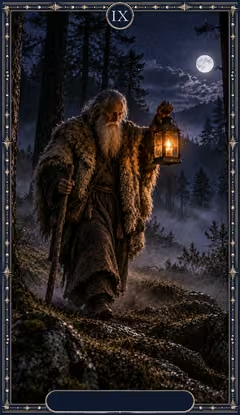
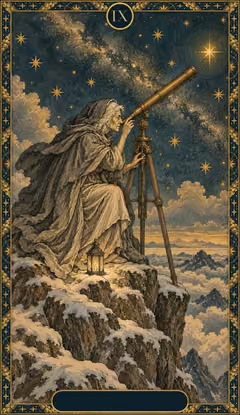
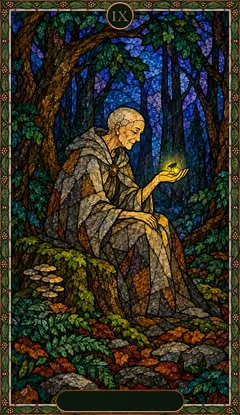
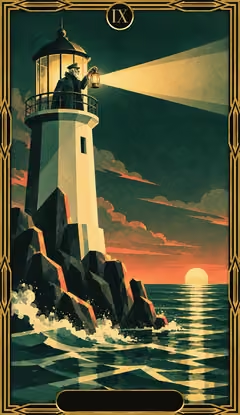
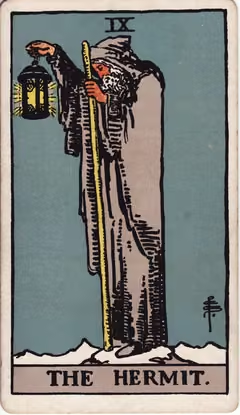
On this card, you see an old man alone, walking or standing on a cold, isolated summit, wrapped in a gray cloak. He holds a lamp in one hand and a staff in the other.
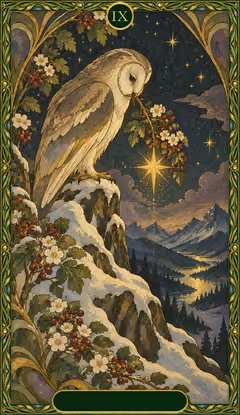
This star has six points: it is formed of a triangle pointing down and a triangle pointing up. The downward triangle stands for withdrawal from the outside world to awaken the inner life. The upward triangle stands for the guide who shows how to begin: a teacher, a therapist, your dreams or an inner guide. The star also stands for the goal of reuniting the opposites of life.
When the lamp is hidden under the cloak, it stands for the light of the unconscious hidden beneath ordinary consciousness. When it is visible, it shows that this light is released through a work of becoming aware, open to anyone. The Hermit holds his light high, on a summit, and it says that you too can reach where he is. The card is a card of attainment.
The staff looks like a magician's and like the Magician's wand. The Fool used it by instinct, while the Hermit leans on it consciously: it stands for the teaching that opens inner awareness. In the Tarot de Marseille, the vertical staff marks the axis that stays fixed while the Hermit moves forward: he keeps his orientation and does not get lost. The Fool's dog is no longer there: instinct has not disappeared, it has been integrated, and it is consciousness that directs the movement.
The beard symbolizes experience. Nine is the last digit of the series: it stands for completion, and so for mastery and the most accomplished state of consciousness. The card carries the Hebrew letter Yod, which means the hand. The summit is high, and the Hermit looks down at the path of those climbing toward him. The paths rising from all sides of the mountain meet at the same point, and his view is wider than that of the walkers. The image shows solitude without the feeling of being abandoned.
What the card means
The Hermit first of all means a withdrawal from the outside world to activate the inner life. The withdrawal can be physical, but it does not have to be: the essential thing is to move your attention from what took up all your time to your inner needs. This takes distance from others and from activities that mattered a great deal, with a specific purpose: working on yourself. The withdrawal is therefore chosen. In the Tarot de Marseille, the Hermit's solitude comes from his lucidity.
The card also speaks of maturity and of knowing what really matters in a life. It shows a long time of ripening, where you move forward step by step and cut away what is not essential. The Hermit seeks to see rightly and does not seek to convince. He evokes prudence and circumspection. He also stands for the scholar who sheds light on the mysteries of nature gradually and with extreme caution. His light comes from within and practical projects follow from it, with a withdrawal from what goes on around him.
The card points to a guide, a mentor or a teacher. It may be a real person who helps you discover yourself, sometimes without your having recognized them as a guide. You may also be the one who guides others and whom people ask for advice. Because 9 is the last digit, the card carries the responsibility of serving others with what you have attained. It also concerns the search for truth and knowledge outside traditional paths.
It can show up as a wish to withdraw from distracting influences in order to concentrate, to perfect a technique or to finish a project. It can turn you toward meditation, keeping a journal or therapy. You may also look for what gives meaning to an experience you have lived, and rely on your past to choose your direction. You do things your own way, discreetly and without trying to be noticed.
Your strengths
You have maturity and a good idea of what matters to you. You know how to withdraw to concentrate and work on yourself. You are discreet and you think before acting, relying on your experience and on a view of your own. You can serve as a guide to others.
What holds you back
- You risk withdrawing for too long: the more you put distance between yourself and society, the more the withdrawal takes over, up to fear of others and distrust.
- You can hold yourself and others to impossible standards.
- You can be so cautious that it turns into distrust, refuse to listen or fear examining a situation too closely.
- You can feel alone and fear growing old alone.
What helps
Move your attention from what occupies you to your inner needs. Do specific work on yourself, through meditation, analysis or a discipline of the mind, to let what is hidden in you speak. Accept the help of a guide or teacher, by looking at the people around you. Cut away what is not essential and move forward step by step. When the time comes, get involved with others again. Make time to be alone if you are in a couple, whether you or your partner.