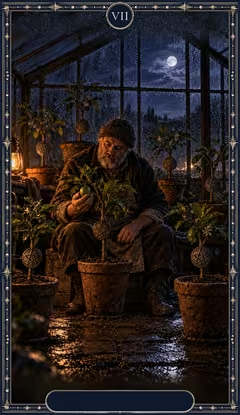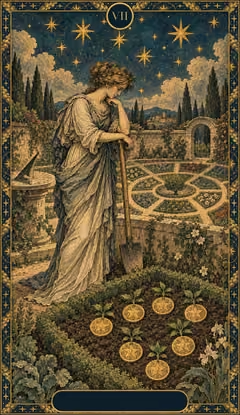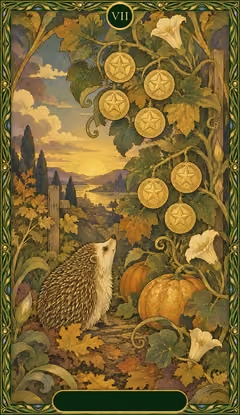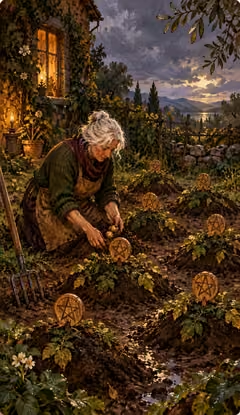
Seven of Pentacles upright
The Seven of Pentacles is the card of effort, patience and taking stock. You may be looking at what your work has produced, to decide whether it was worth it. The card puts you to the test: it asks for skill, courage and determination to show that you can succeed.
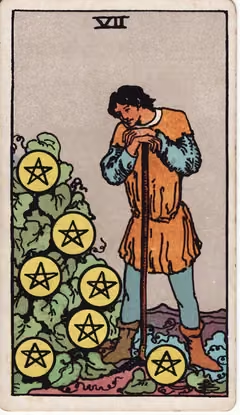
In the Waite-Smith deck, a man leans on his staff and looks intently at seven pentacles hanging on a bush, which he seems to care about a great deal. What you started is beginning to show results, but you need patience and trust, because a natural cycle of completion can't be rushed. It can also point to an investment you are keeping an eye on, or to an inventory you are taking.
This card often speaks of money, business and exchange, but its traditional meanings contradict each other a great deal. It can also say that it is time to sort things out, throw away what is damaged and keep only the best. Sometimes it simply means it is time to take a break and wait for what comes next. Its meaning depends heavily on the cards around it.
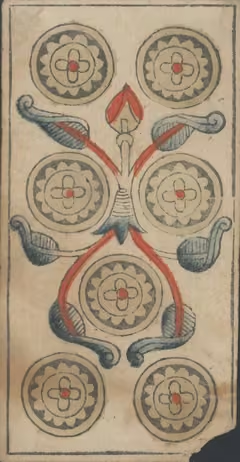
In the Marseille Tarot, this is a card that affects the cards around it more than they affect it.
Your strengths
- You can keep going through a long effort and wait for the result.
- You have ingenuity.
- You know how to assess what your efforts have produced.
What holds you back
- You may sabotage yourself out of fear of success, because you don't believe the payoff can be yours.
- You may fall into perfectionism and procrastination.
- You may be indecisive and imprecise.
- You risk not getting what you worked for.
What helps
- Take good care of what you have started.
- Let things reach their end without trying to hurry them.
- Take the neighboring cards into account before you conclude.
Seven of Pentacles reversed
You may feel a vague unease, worry and melancholy without knowing the exact cause. You are impatient, or procrastination sets in. You may believe that someone is trying to steal your ideas or your belongings, which keeps you constantly on guard. If the other cards confirm it, your distrust and suspicion may be justified. Complications arise. There is always more to do, to the point of exhaustion, and you find it hard to rest. Problems often come up at work: the earnings or pay are not worth the time and effort you put in. You may feel reduced to the role of the one who works, without receiving the money, recognition or benefits once the work is done.
Your resources may be overdeveloped and leave an unused surplus. Or, the other way around, nothing grows. Your investments and methods do not go as planned. The amount of work that remains, or money spent without return, can overwhelm you. When you project this onto others, you see them as lazy, or investing in the wrong place, or on the contrary paranoid about losing. On the inner level, this card is about putting the same attention and energy into everything you do, both before and after a moment of awareness. In magical practice, it refers to what you do with an altar or a ritual: after setting your intention with care, you leave the process alone and trust it to work.
The traditional meanings of the reversed card are anxiety, trouble, worry, melancholy, a tormented mind, impatience, distress, complications and setbacks, distrust and suspicion, care, attention, diligence and unwise investments.
What holds you back
- You feel worry, melancholy and an unease you cannot name.
- You are impatient or you put things off.
- You fear that someone will take what you have created, and you stay on guard.
- You work to exhaustion and can no longer rest.
- You feel overwhelmed by the work that remains or by spending with no return.
- You see others as lazy, misplacing their efforts or paranoid.
What helps
Putting the same attention and energy into everything you do. After setting your intention, leaving the process alone and trusting it.
What the card shows
In the most common version of the card, a young man leans on his staff and looks attentively at seven pentacles hanging on a leafy bush to his right. He seems to hold on to these pentacles as to his possessions. A farmer watching over his harvest fits this image: he may be waiting for the right moment to pick. The pentacles here are the living result of work: the card shows the moment when you can look back with satisfaction at what you have accomplished. What has been built, including bonds between people, has reached a point where it can grow on its own, and you can step back without everything collapsing. Work that gives meaning pays more than money: the person grows too.
There are only five buds, which hang over the top five pentacles without touching them. This shows promises of success that do not come to fruition. The seven pentacles form a geomancy figure called Rubeus, judged ugly and threatening. They are lead discs, associated with Saturn, which suggest bad coinage. The background shows damaged vegetation and crops: the atmosphere of the card is that of plants suffering. The symbols of Saturn and Taurus are above and below the image. The number seven corresponds to Netzach, whose effect weakens; Saturn in Taurus is a good association, but set so low in the material world, it is not enough to make up for the rest. This version of the card is called Failure: there is no more effort, the stake is played and lost.
The meaning of the card depends heavily on the cards around it. It is first a card of effort, patience and taking stock: you assess your harvest to see whether the effort was worth it. It calls for skill, courage and determination to show that you are succeeding. Projects are beginning to bear fruit, but it takes patience and trust, because natural cycles cannot be rushed. It can also mean taking a pause and waiting for what comes next. Its old meanings are money and profit, gain through hard work, slow progress, obstacles to an undertaking, and also sorting: getting rid of what is damaged to keep quality. The meanings attached to the card are very contradictory: money, business, exchanges, but also quarrels, innocence, ingenuity or purification. In the dark version, it announces small, isolated gains with no follow-up, and little profit for a lot of work.
Your strengths
You know how to persevere in long work, and you have the patience to wait for what you have sown to ripen. You show courage, skill and determination in the face of trials. You know how to take stock of what you have built and be glad of it. You know how to sort and keep only what is of quality.
What holds you back
- You may be afraid of succeeding: you don't believe the reward could be for you and you sabotage your own potential.
- You can fall into perfectionism and procrastination.
- You look only at the success and not at the work that leads to it, which makes you impatient, frustrated, envious or jealous.
- You worry, you find it hard to rest and you have the feeling there is always more to do, to the point of exhaustion.
- You may be wary, think people want to steal your ideas or your belongings and stay on your guard.
- You may feel your work earns you neither money nor recognition.
- You may feel trapped in a job or a commitment that satisfies you little.
What helps
Tending carefully what you cultivate. Letting time do its work, without trying to rush the ripening of what you have started. Putting the same attention and the same effort into everything you do, once your intention is set. Taking stock of what has been accomplished, then stepping back.