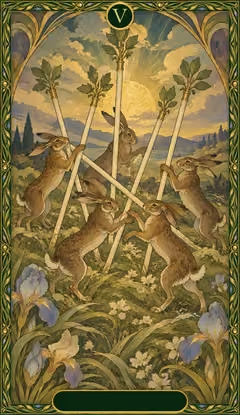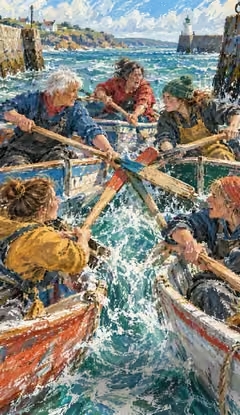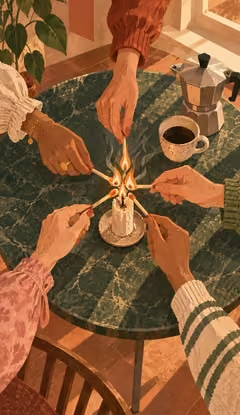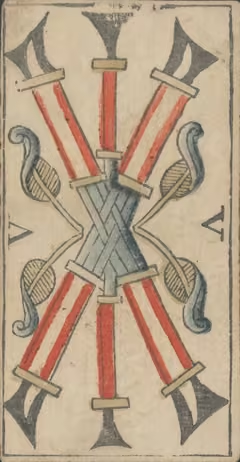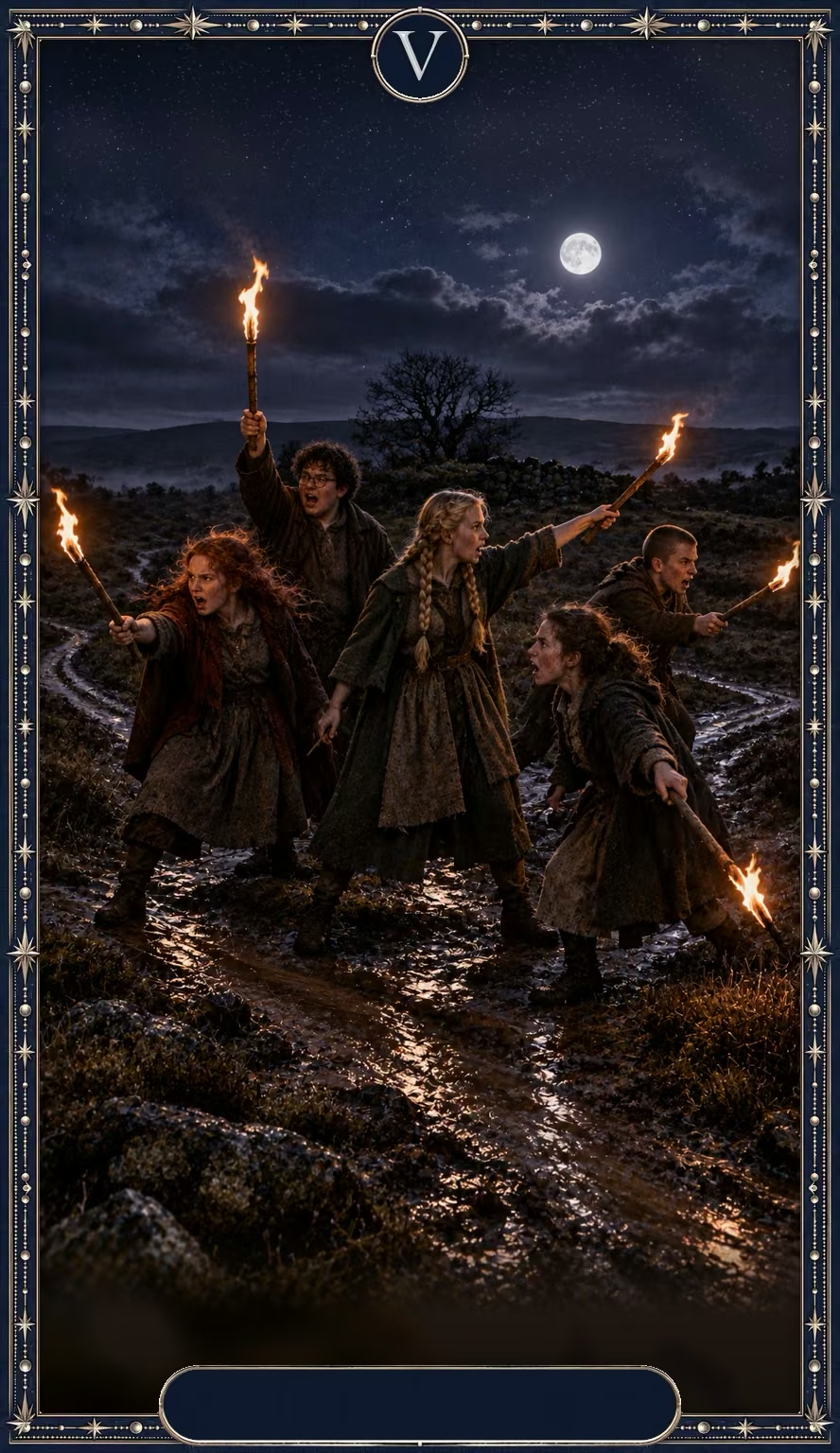
Five of Wands upright
This card speaks of conflict and competition. Your situation involves rivalry, disagreements or a struggle to succeed, to be heard or to win your place. It comes to break a moment of harmony and stability: movement replaces calm, which creates restlessness and tension. This tension shouldn't be seen as an evil, but it remains a real disturbance.
In its light version, it is a confrontation that resembles a game. People oppose each other without trying to hurt, for the pleasure of acting and measuring themselves against others. This competition assumes rules understood by everyone and fair play. It is also a way of communicating with others and with society. It corresponds to team games, brainstorming and problem-solving: you test your ideas through disagreement and explore several points of view. It can also show a conflict among several desires within you.
Traditionally, it is linked to gold, wealth, abundance and gain. You can move forward and succeed, but you have to work hard and get past obstacles to do so. You may also be stimulated by this situation: it awakens ardor and desire. Once the agitation passes, this energy brings success.
In its harsh version, the card speaks of quarrels and fights, of violent struggle. The energy is very active and without limit, but it is weighed down and soured by constant resistance. The situation is full of contradictions: a strong push runs into a heavy obstacle. What began as a game can turn into anger and destructive criticism. The rules are then dropped, the tone turns bitter, and each person tries to harm the other. The meaning depends on how the card is lived: lived well, it gives boldness and generosity; lived badly, it gives recklessness, cruelty and violence.
Your strengths
You have a taste for challenge and competition. You have an active, strong energy. You have ambition and you can succeed through hard work. You know how to test your ideas against other people's.
What holds you back
- You rush into conflicts with no goal or plan, out of sheer pleasure in rivalry, and you attract problems that way.
- You become aggressive and full of animosity when you fear that your ideas or desires won't be recognized.
- You slide from play into destructive criticism and anger.
- You lose the sense of play: rivalry turns into bitterness and disillusionment, and you try to ruin the other person.
- You can be extravagant and let your desires lead you.
- Excessive pride or a hot temper can spoil your success.
What helps
Keeping clear rules and fair play in competition. Cultivating a free, joyful expression of ideas and looking at several points of view. Working and persevering in the face of obstacles.
Five of Wands reversed
The upright Five of Wands speaks of rivalry, power struggles, competition, ambition and pride. Reversed, it concerns how you experience a conflict: it can be resolved, move inside you or change form.
The conflict can be resolved. You can get out of a deadlock or end a period of tension and stress. A legal or professional intervention may then be necessary. When disagreements ease, you can end up working together, reaching an agreement and stopping the hostilities. You can then rest and enter a period of calm and relief.
You can also choose not to join the game. You refuse to play other people's games, or you try to defuse an explosive situation by not getting involved. You do not always manage: others may harass or persecute you, even to the point of taking legal action against you. Someone may also sabotage negotiations to keep the situation unstable and murky. This card evokes disputes, legal proceedings, quarrels, cunning, deception, irritation, squabbles and contradictions.
The conflict can also take place within you. Reversed, the tension sometimes becomes inner: you feel private conflicts, you find it hard to decide and your priorities are unclear. You may be afraid to speak up or hesitate to stir up controversy. You may try to narrow your options instead of opening them to discussion. Animosities can escalate into big fights, or fall back into exhaustion.
You may also attribute the disorder to others. You imagine yourself calm and detached, and you think they are the ones creating the hostility and disruption. You may also suspect them of cunning.
This card can take you back to the card before it, the Four of Wands. The new energy does not express itself fully because of what is still attached to the past, and you may have to go back over its lessons.
Your strengths
You can defuse a tense situation. You can succeed, together with others, in agreeing on a shared goal to stop the hostilities.
What holds you back
- You can have trouble deciding when you are torn between several wishes.
- You hesitate to speak or to create controversy.
- You restrict your options instead of discussing them.
- You can feel exhausted when tensions last.
- You can see the source of the disorder in others and believe yourself calm.
- You can use cunning to stir up a quarrel, often to divert attention from your real aim, and then slip away.
What helps
Calling on legal or professional support when the situation requires it. Asking yourself what is still left to learn from the Four of Wands.
Work
In the workplace, this reversed card can show an atmosphere of hostility, cunning and unfair competition that makes work unpleasant. It can also call for a professional intervention to get out of a conflict.
What the card shows
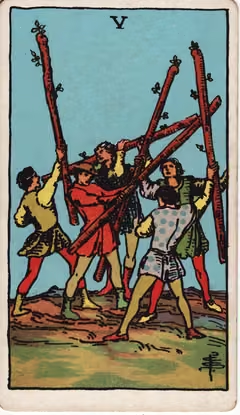
The image
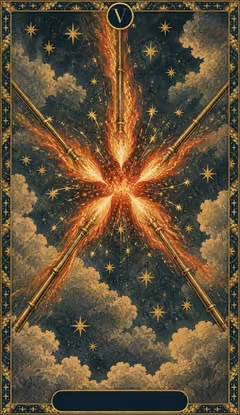
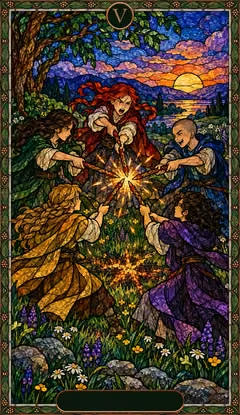
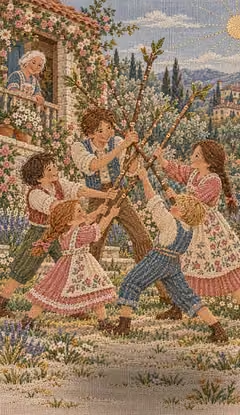
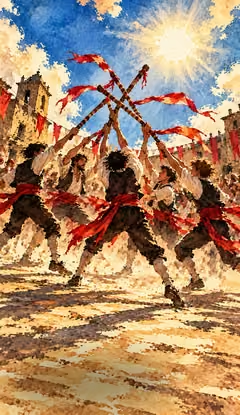
In the Waite-Smith tarot, a group of young people brandish wands, as if playing or quarreling. It is a mock war, an imitation of combat. The young people fight without trying to hurt each other: they clash their wands without touching anyone, for the pleasure of acting. In this image, five people also seem to be building a pentacle, a symbol of power and protection.
It shows that authority comes from the higher powers, otherwise the card would be disastrous. Two wands of the Adeptus Major carry a phoenix head: they say destruction, or rather purification by fire, then the return of energy from its ashes. Two wands of the Adeptus Minor come from the Three of Wands and bring the softening influence of the Mother. This energy without brake or reason is nonetheless born from the gentle influence of the feminine.
In an old model, two white hands come out of the clouds and clasp each other with the grip of the first degree. They hold five wands or torches: one wand stands upright in the middle, the others cross, and flames burst out where they meet. The sign of Saturn is above the central wand and that of Leo below it, which points to the decan. Another version shows four wands crossed two by two, with a fifth, straight wand held by a third hand coming out of a cloud. The color of Gevurah is orange.
What it means
Five breaks the harmony of four. It introduces movement into a stable system and upsets it: storm and tension arrive. This upheaval is not to be judged bad in itself, but a disturbance remains a disturbance: the Five of Wands is called Strife. Five belongs to Gevurah, a purely active force. The card is tied to Leo, where fire is at its strongest and most balanced, and to Saturn, which weighs it down and sours it. The energy of this card has no limit. It corresponds to Saturn in Leo, from July 22 to August 1.
Fire sees life as a fight, and in its best form the fight becomes an exciting struggle that you seek out. Fives generally bring a difficulty, but fire turns it into competition, a way of communicating with society and with others. A competition that is well lived requires rules and fair play, without which struggle as a game becomes impossible.
This card speaks of quarrels, competition, power struggles, ambition and pride. It also speaks of team games, brainstorming and problem solving, where you test your ideas through disagreement. It can stand for the conflicting desires of five parts of you. It also evokes the struggle for wealth and fortune, the battle of life, hence gold, gain and opulence. Depending on whether it is well or badly placed, it says boldness, rashness, cruelty, violence, desire, extravagance and generosity.
Reversed, the card shows that the rules are abandoned and that the fight takes on a more serious and nastier tone. The game turns into bitterness and disillusion, and each person tries to hurt or ruin the other. Fire, when the awareness of Swords does not accompany it, demands that life respond positively and not show its cruel side. It can also say the end of a period of conflict, or an inner agitation that makes decisions hard and priorities blurred. It carries meanings of lawsuits, quarrels, deception and contradictions.
What holds you back
- You can let a competitive game slide into anger and destructive criticism.
- When you fear that your ideas will not be recognized or your desires not met, you can develop animosity.
- You can be reckless, cruel or violent.
- Excessive pride or an irritable temper can spoil your success.
- You can be torn between several conflicting desires.
What helps
Set clear rules and play fair. Explore several points of view, letting ideas be expressed freely and with humor. Work hard to overcome obstacles when you want to move forward.