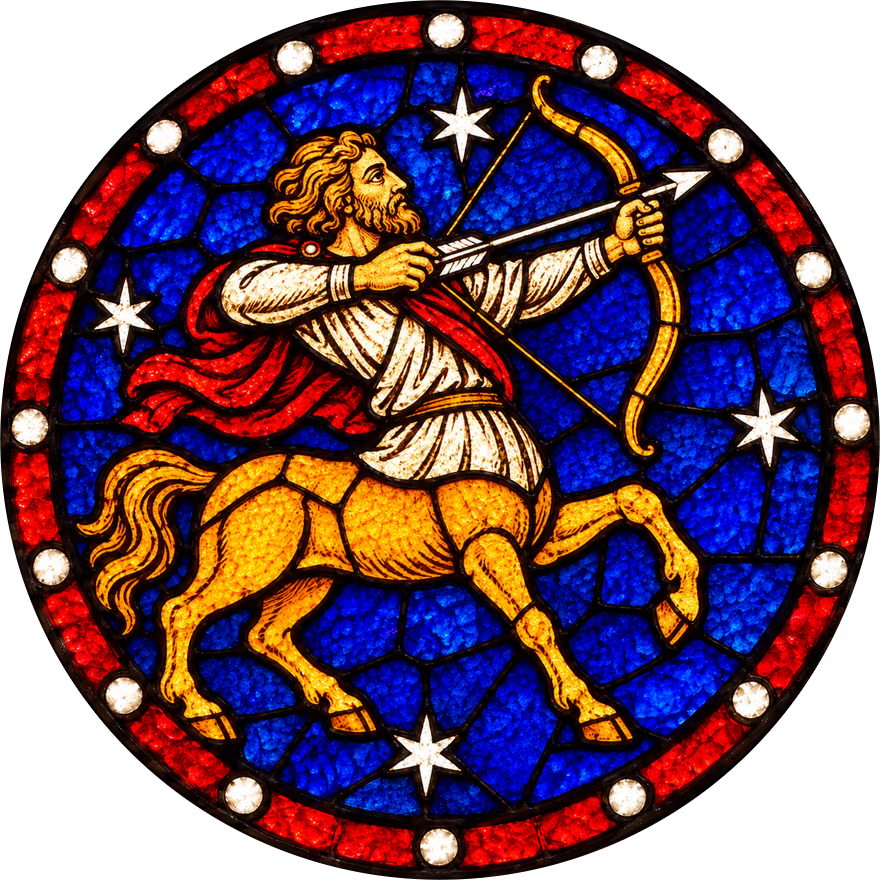
Chiron in Sagittarius
Your wound touches the meaning of life and faith.
Chiron often shows where you met your first wounds and what you learn from what you live through: over time, your wounds become a source of wisdom.
Chiron is the point of the wound and of healing: it shows what you learn from your experiences.

- Planet
- Chiron
- Sign
- Sagittarius
- Element
- Fire
- Fire is the element of Aries, Leo and Sagittarius: drive, enthusiasm and self-confidence.
- Modality
- Mutable
- The mutable modality belongs to Gemini, Virgo, Sagittarius and Pisces: adapting, changing, adjusting.
- Ruler
- Jupiter
- The planet that rules this sign.
What it means
What drives you is religious in nature, even if it does not show at first glance. This search often wakes up early: from childhood you ask the big questions about the meaning of life, and you may never receive an answer that satisfies you. As a child, you may have concluded that adults were stupid, because they seemed to know nothing about these big questions and take no interest in them. Sometimes your quick mind and your eagerness to understand leave you feeling alone, especially if as a child you lost the feeling of being safe with wise adults who knew.
Often the religious framework you inherited does not answer your inner needs, and you take a long road, sometimes a solitary one, to find your own meaning and your own purpose. You may have inherited a conflict or confusion around religion, for example parents who argued about it. It may also be that your parents or ancestors emigrated, that you grew up in a foreign culture, that your parents are foreigners or exiles, that your religion is not recognized, that you live in a country in the middle of cultural change, or that your family’s beliefs set you apart. You may feel wounded by God. You may be sensitive to ideas like original sin, and believe, when things go wrong, that God has it in for you. These questions demand your attention, and it is your own awareness that can resolve them.
Sometimes this path goes through real journeys: you become a great traveler, pilgrimages to holy places nourish you, or you see life itself as a journey. You may often dream of sacred places and return to them in your mind. Contact with nature, especially in wild places, restores your strength.
You have a deep sense of devotion: you need to give yourself passionately to something. When this need goes to the wrong object, anything can take the place of the sacred, food, studies, the film of the moment, and you pursue it with fervor; but the deep dissatisfaction that is your wound cannot be filled this way. Your fervor can take you far if you embrace a cause or follow a spiritual path where your own questions and reflections are set aside. If you place your ideal of the divine on a teacher or a leader, your burning wish to find the Truth can cloud your judgment, and you can then be taken advantage of. This teacher may be, at bottom, just an idealized father or mother figure. When your fervor awakens, your old wounds can wake up too, and it becomes hard to detach from an idea, a group or a teacher, even when you can see clearly that you should.
You can see a personal meaning in everything, and that inspires and stimulates you. But your enthusiasms do not always meet what matters to others, and your detours, your bursts of excitement and your disappointments can wear on your friends. Finding meaning in everything can also serve to defend you against your pain: you may force yourself to seem open, positive and outgoing to cover a layer of despair and dejection. At other times, you have trouble finding meaning in anything at all. Deep down, you may carry a hope or an ideal that cannot be realized, which you are not aware of and which sometimes dates from childhood; letting it come into your awareness can bring you great relief. It can also happen that at some point in your life you glimpse a powerful vision of other dimensions, then suffer because you can no longer believe in it or live in line with it. You then feel an intense frustration: you sense something in you to give, without finding how to give it or being able to say what it is.
Your sense of what is possible can make you suffer: your intuitions go in every direction, but you find it hard to commit and to find a direction in which to express them. You discover with discouragement that things do not happen by themselves, and you hesitate at the moment of acting: you hold on to the possible and avoid the result. Others can discourage you, and your enthusiasm, like your tendency to overdo it, can collapse many times before you accept the gap between what can be achieved and what cannot. Giving up an ideal or a hope that cannot be realized costs you a great deal, especially when you have put your whole identity into it. When you accept this renunciation, your ideal stays alive and your relationship to it becomes healthier.
Faced with a great ordeal, or a task that absorbs you entirely, you may strike a bargain with life in your head: you accept the effort on condition that you are rewarded afterward. When life does not hold up its end, you feel deeply disappointed, even betrayed, when in fact you alone set the bargain, and the suffering that follows comes partly from you. Your refusal to accept things as they are is both a quality and a weak point. It keeps you optimistic, turned toward what is positive and toward what a difficult situation makes possible. But if you stifle your disappointment, you start running nonstop after material or spiritual goals.
After searching in vain for lasting meaning in what is outside you, you may come to understand that there may be no ultimate meaning, and that meaning is a quality you put into what you live yourself. Sometimes your optimism and your taste for going outward seem blocked while your inner understanding grows. If you accept this turn inward, you develop practical wisdom, a kindly humor and an open, warm attitude toward life. Your gift may be to devote yourself to appreciating life, here and now, as an expression of the divine: when you trust its presence, you no longer need to chase it. This trust is hard won, and your quest can start up again at times, before you let it go once more. The wisdom you gain in this quest serves you and others alike.
Your strengths
- You have a quick mind and a taste for the big questions.
- You are optimistic: you move toward what is positive and toward what difficult situations make possible.
- You know how to find meaning and draw inspiration from it.
- You have a deep sense of devotion and fervor.
- When you agree to turn inward and drop your conditions, you gain practical wisdom, warmth, a kindly humor and an open attitude toward life.
- What you have understood in your quest also serves others.
What holds you back
- You may give yourself to a cause, a group or a teacher to the point of silencing your own questions, and find it hard to detach.
- You may believe you hold the Truth and want to announce it to everyone, to the point of upsetting your personal life.
- You may only spend time with people who share your beliefs.
- You think in all-or-nothing terms: if you are right, the other person is wrong, and you believe you are doing them a favor by trying to convince them. Most often you do not say so, but this silent certainty weighs heavily on people who are easily influenced.
- When you do not listen to your inner wisdom, you may start giving advice nobody asked for, and find it hard to listen without wanting to fix everything.
What helps
- Keeping a little lightness and reason in front of a teacher or spiritual guide.
- Looking at what, or who, occupies the place of the sacred in your life.
- Accepting the gap between what you imagine and what can be achieved.
- Recognizing that your goal depends as much on who you are as on what you do: your ideal then nourishes you instead of pushing you, and you can act in a fruitful way.
- Paying attention to how you live through disappointments, without stifling them.
- Dropping the conditions and accepting things as they are.
- Looking for a truth that makes room for your feelings and does not depend on dogma or custom.
- Listening to your personal calling: that is where you find meaning, whatever others think.
- Resisting the urge to turn everything into a task to accomplish outside yourself.
- Recharging in nature, especially wild nature, in travel and in holy places.