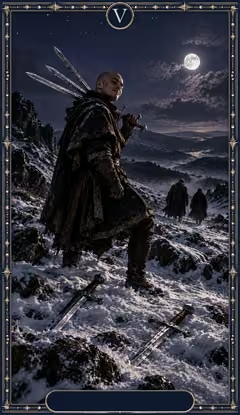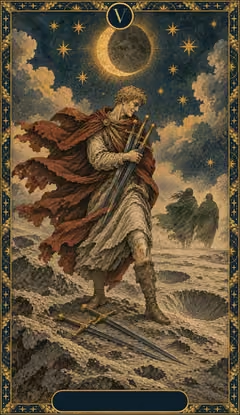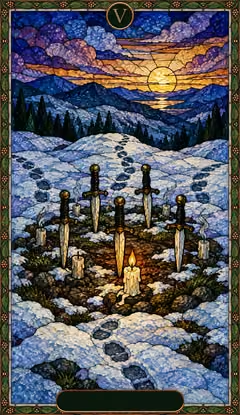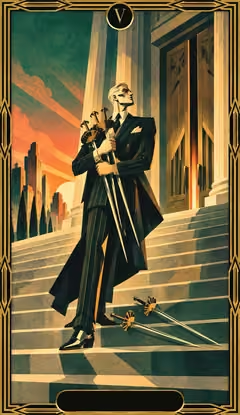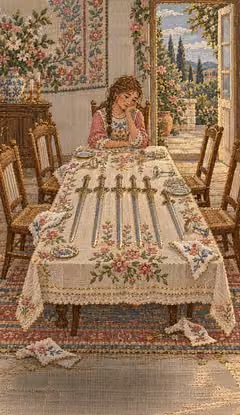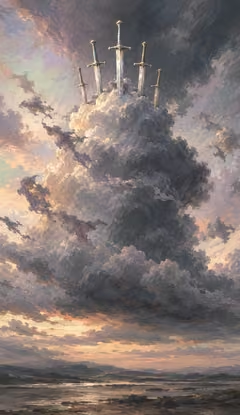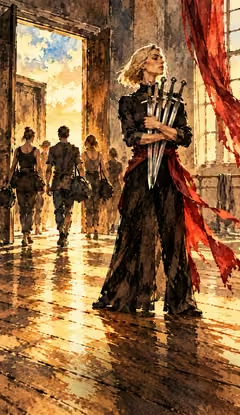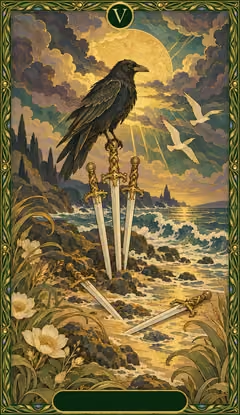
Five of Swords upright
The Five of Swords is the card of defeat. It speaks of loss, degradation, failure and dishonor. A conflict has broken out: the armed peace that held in the Four did not last, for lack of strength to maintain it. The number Five brings movement into a stable order, and with it tension and agitation. The fight the card shows is already decided: it ended against you.
In your situation, you most often recognize yourself in the two figures walking away. You have lost a battle, everything around you weighs on you, and you feel weakness and humiliation. You may also recognize yourself in the winner, left master of the field, who profits from the misfortunes of others. The enemy can be a person, an overall situation or an inner feeling of inadequacy.
Communication is often broken. Your thinking is fragmented, and you may feel scattered or attacked. The defeat can come from a mind too weak against feeling: the intellect has weakened through sentimentality and excess pacifism, and betrayal is possible. It can also come from the opposite: a literal, abstract mind, armed with facts, has beaten the tenderer feelings. The principles defended may be just and ethical but lack kindness and understanding, or else underhanded methods are used.
This situation has no way out: you may win the battle and lose the war, or end up without friends or support. From pride to humiliation, no attitude moves you forward, and nothing gets settled. If other cards point the same way, the situation may be abusive. The card also says a bitter struggle to reach higher planes and the wish to sacrifice the body to the spirit, a struggle that does not succeed. The Swords cut experience into parts, which distorts and exaggerates it, and they are more pessimistic than the major cards.
Your strengths
You have a quick mind: you think and speak fast. Your pity is easily awakened.
What holds you back
- Your pity does not last.
- You can be spiteful, resentful, backbiting, untruthful and given to telling tales.
- You can sow discord among friends and find it hard to see peace and love in others.
- You can be cruel and cowardly at once, ungrateful and unreliable.
- You are anxious, you wear yourself out without resting, you are stingy and you regret what you have earned.
- Your thinking splits and turns negative, and the division creates disagreements.
What helps
- Choosing between saving the situation and withdrawing.
- Breaking a big task into smaller parts.
- Completing your thinking with experiences and attitudes of another kind, because thought alone cuts and distorts.
Five of Swords reversed
The Five of Swords speaks of conflict, loss and defeat, and it keeps that meaning reversed. Upright, the card shows the moment of defeat. Reversed, it extends that moment into the despair felt afterward, a state that is hard to move beyond. The reversed card adds the idea of mourning after the confrontation.
You may see yourself in the person who lost, humiliated and weakened, with the feeling that everything weighs on you. The adversary may be a real person, an overall situation or an inner sense of inadequacy. You may also sense that others are trying to thwart what you undertake.
The reversed card invites you to look at what is growing underneath. When a pain becomes unbearable, your personality can split: a hard part takes over, and the wounded part withdraws and buries itself deep inside you. Abstract idealism can also come into play: you place principles above people, and you show little regard for those who do not serve your cause. A conviction such as patriotism then lets you hold on to a "truth" or a task despite the suffering it causes others.
The reversed card can also mean the end of a conflict or disagreement. When the air clears, the question is what can be saved: bringing people together rather than weapons, repairing, asking forgiveness, settling what each owes the other. It also shows the possibility of growing after a loss and a sorrow. A fault or a betrayal may be revealed.
This card does not favor new projects, upright or reversed. Reversed, it suggests you settle the problems that trouble you.
What holds you back
- You feel humiliated and weakened by a defeat, and that feeling lasts beyond the moment itself.
- You are afraid that everything you have built will come apart, and this fear can prepare the very defeat you dread.
- You risk ending up with no practical result despite your efforts.
- You put a principle or a mission before people, and you can be insensitive to their pain.
- You bury your wounded side instead of acknowledging it.
What helps
- Ending the conflict, repairing damaged ties and asking forgiveness.
- Seeing what can be saved after the loss.
- Leaning on your friends and not giving in to your fears, especially in periods when nothing moves forward.
- Getting help from other influences, especially those of the Wands, to come out of despair.
- Refusing to feel defeated.
What the card shows
The Five of Swords is the card of defeat. The number five introduces movement into a stable whole: storm and tension arrive. That is not bad in itself, but it is a disturbance. After the respite of the Four, the battle breaks out. The quarrel began because there was not enough strength to keep the armed peace of the Four. All the Fives show conflict or loss, and the Swords push this idea as far as defeat.
What the image shows
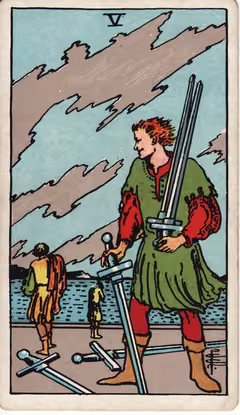
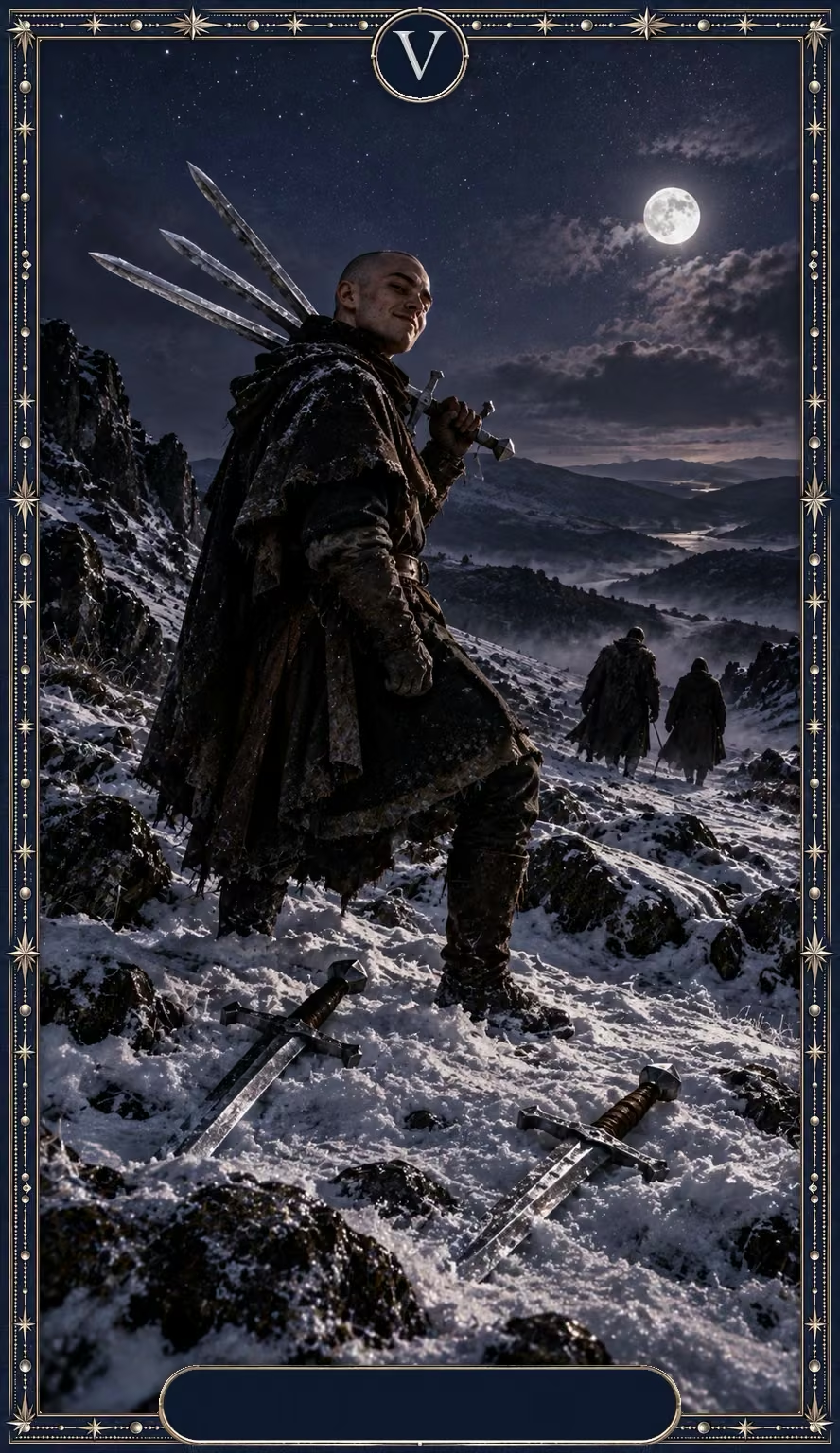
In the classic image, three figures are present. In the foreground, one of them seems to have the upper hand over his opponents. He profits from other people's misfortune, like someone picking up what they leave behind. The one farthest away looks beaten and dejected. The one in the middle walks away, perhaps because he refuses to fight. The water is rough and the sky jagged, as if the whole setting weighed on those who have lost. The ragged clouds reflect a stormy mood. What dominates for those who have lost is weakness and humiliation. Most often you identify with the two figures walking away, more rarely with the winner.
What the card says about a situation
The Five of Swords speaks of a fight, with opponents and fighting attitudes. You may be arguing, or you feel attacked or scattered. Communication often breaks down. The principles being defended may be right and honest, but without kindness or understanding, or else unfair methods come into play. Thinking is fragmented. The mind that lines up facts has taken over from the gentler feelings. The situation has no way out: you win a battle while losing the war, or you find yourself without friends or support. Nothing gets settled, whether you feel proud or humiliated. Defeat can also come from weakness rather than an excess of strength: intelligence has been weakened by feeling, and a refusal to fight can lead to failure. Betrayal is also possible. The opponent may be a real person, an overall situation or an inner feeling of inadequacy.
The card reversed
The Five of Swords keeps roughly the same meaning reversed, with mourning after the carnage added. Where the upright card shows the moment of defeat, the reversed card extends it into the despair that follows. This is a hard state to get past, and other influences, especially those of the Wands, can help. Reversed can also mean burying the hatchet and ending a conflict. When the air clears, you look at what can be saved: gathering people rather than swords, repairing, making amends. After pruning, most plants grow back: the card also carries a potential for growth after loss and sorrow. A hidden wrong may then be revealed. Upright or reversed, it does not favor new projects.
The domain of the card
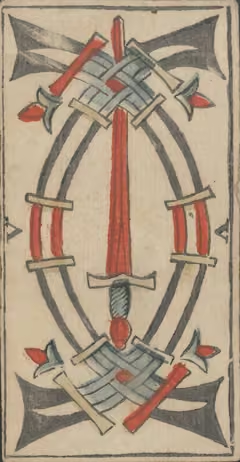
The Swords are more pessimistic than the Major Arcana, and they cut experience into pieces, which distorts and exaggerates it. A spread with many Swords needs to be balanced by the other suits. The card is associated with Venus in Aquarius and with Gevurah, severity. The Tarot de Marseille gives it a two-level meaning: a fierce struggle to reach a higher plane, with the desire to destroy the body for the sake of the spirit, and in practice a defeat, a struggle without result.
Your strengths
You may refuse to feel defeated.
What holds you back
- You feel attacked, scattered or in conflict, and you see opponents everywhere.
- You defend your principles without kindness or understanding.
- You may feel blocked in your plans by others.
- Your pity wakes easily but does not last.
- You defend an abstract idea to the point of staying unmoved by people who have no connection to your cause.
- After unbearable pain, one part of you may cut itself off from the suffering and hide deep inside, while another part turns hard.
What helps
- Breaking a large task into small parts.
- Choosing to save the situation or to withdraw.
- Ending a conflict, repairing ties and bringing people together.
- Solving the problems that hamper you.
- Balance thought with the other suits of the tarot, especially Wands.