Close your circle with four hexagrams
Close a protective circle with four hexagrams drawn at the corners of the space and a divine name vibrated toward each direction.
- 10 min
- 13 steps
Why do it
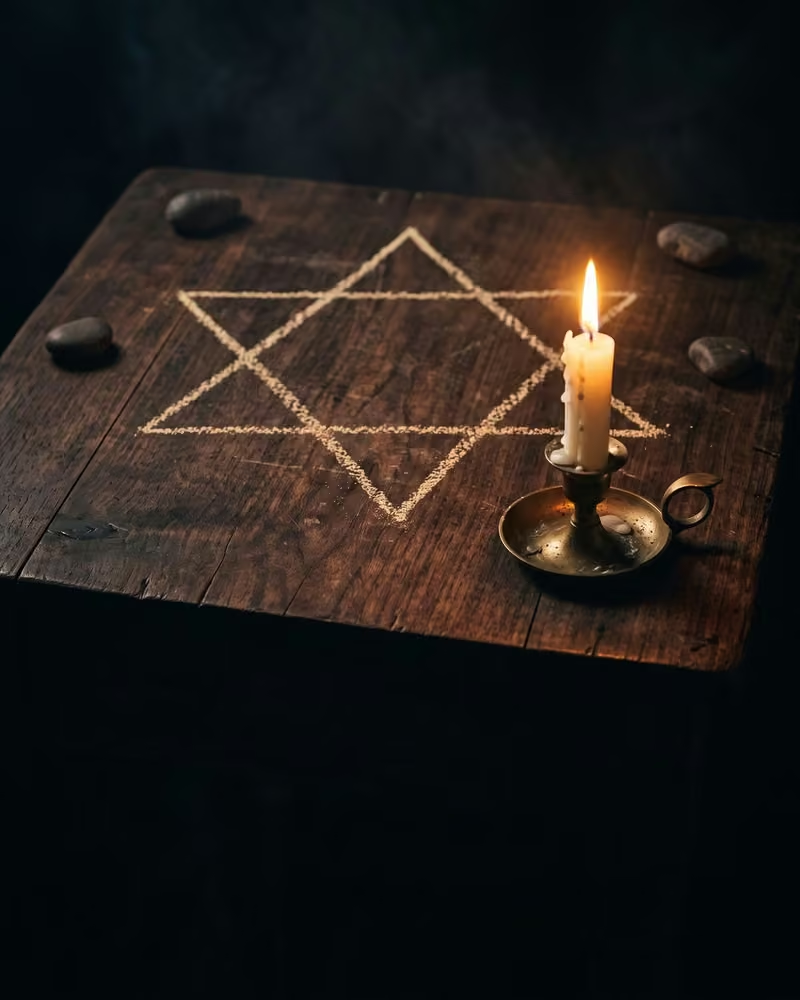
The hexagrams, six-pointed stars drawn at the four corners of the space, act as a rampart against indirect harmful forces. The divine names vibrated toward the four cardinal points push back direct opposing forces. This rite strengthens your aura and disperses the negative thoughts that can cling to it.
How it goes
13 steps
Open the ritual with the guide: the Kabbalistic cross, then the circle of the four angels that protects you. The hexagrams that follow close this circle completely.
If you have just done the pentagram ritual, do not close it with the cross: once the prayer to El and the four angel princes is done, go straight to the hexagrams.
Opening a ritualTurn toward the northeast corner and draw an invoking hexagram, the six-pointed star made of two interlaced triangles, clockwise: the first stroke runs down the right side of the top point, the second runs up the left side of the bottom point.
Pivot to face east and vibrate the name Agla, אגלא, tracing its letters in the air in front of you. It is made from the initials of four words meaning “You are Power for eternity, O Lord.”
Say
Agla
Pivot toward the southeast corner and draw a hexagram again, the same way.
Pivot to face south and vibrate the name Taftafiah, טפטפיה, tracing its letters in the air. It is a name of power whose first syllable is doubled: it comes from Tafiah, “Divine Radiance.”
Say
Taftafiah
Pivot toward the southwest corner and draw a hexagram again.
Pivot to face west and vibrate the name Metzmatzit, מצמצית, tracing its letters in the air. It comes from a root meaning war, with its first syllable doubled, and is close to the Sword of God, which drives away what opposes.
Say
Metzmatzit
Pivot toward the northwest corner and draw a hexagram again.
Pivot to face north and vibrate the name Shaddai, שדי, tracing its letters in the air. It is understood as “it is enough, it is sufficient,” in the sense of fullness.
Say
Shaddai
Close your circle: turn back, arm outstretched, toward the northeast corner.
Stand facing east, arms stretched out in a cross, and sound the final phrase.
Say
The Flaming Messenger, son of purity: may Kuzu protect us.
In Hebrew
Ezguedai Zaraf Bene-Bar Kuzu Yishmerenu
Ezguedai is the Messenger, the angel; Zaraf means shining, sparkling; Bene-Bar, “my son of purity”; Kuzu is a name of God with the same value as “Yhvh is One”; Yishmerenu means “may he protect us.”
Close the ritual with the Kabbalistic cross, with the guide.
The Kabbalistic crossThe four hexagrams are drawn at the corners of the space: according to the tradition, they stand as a rampart around you.
What it is
It is a ceremonial rite of Kabbalah, the Jewish mystical tradition: four hexagrams, six-pointed stars, drawn at the corners of the space, then a Hebrew divine name vibrated toward each direction. It comes after the cross and the circle of the four angels.
What makes it magic
This rite extends a protective talisman. The hexagrams drawn at the four corners act as a rampart against indirect harmful forces; the divine names projected toward the four cardinal points push back direct opposing forces and are an ode to the divine. Agla means “You are Power for eternity, O Lord”; Taftafiah, “Divine Radiance”; Shaddai, “it is enough,” fullness.
When
Whenever you like: the books give it no day and no Moon phase.
It is usually done after the pentagram ritual.
The Asteria app for iPhone
Rituals, guided step by step
Asteria is an astrology, tarot and ritual app for iPhone.
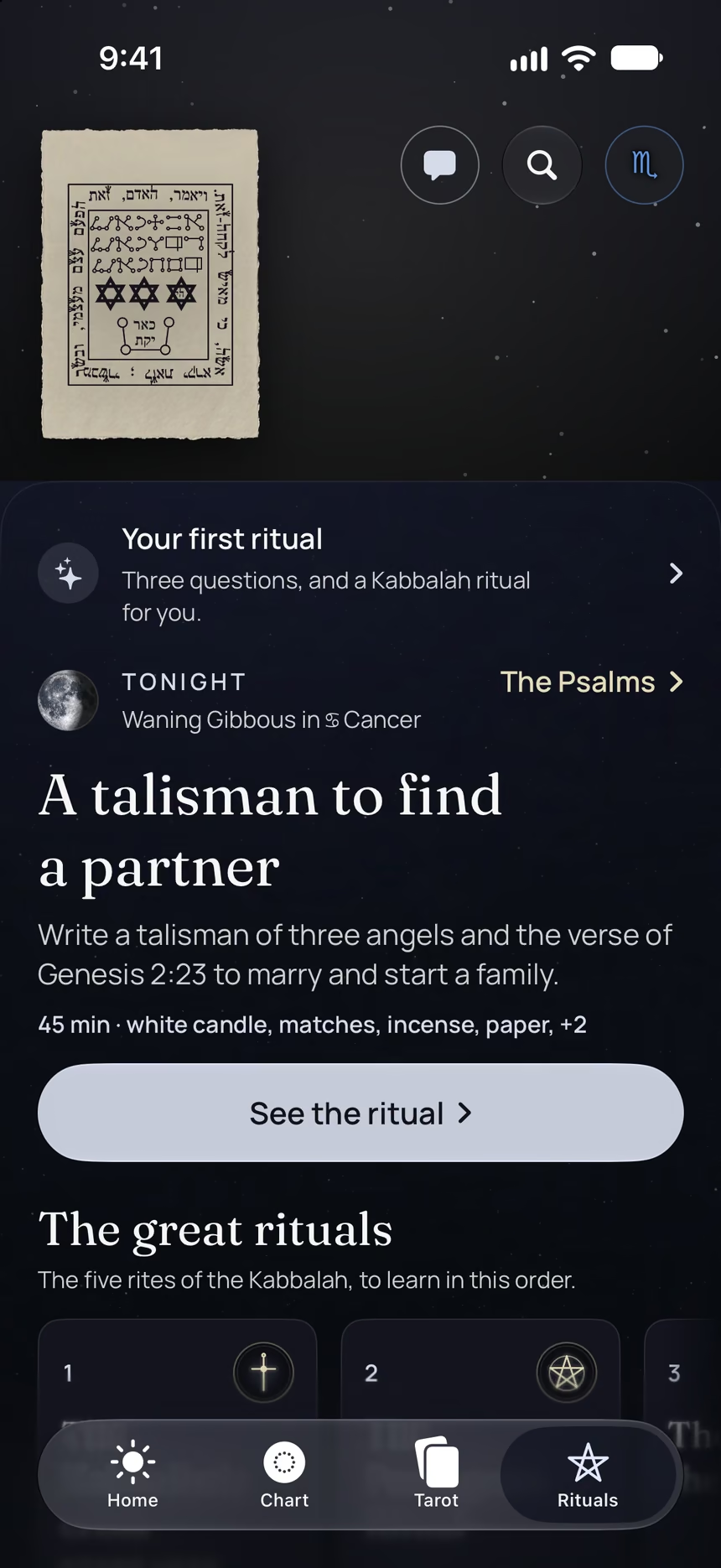
- Its 13 steps, guided one by one by voice, with the words to say.
- The reading of the day.
- Your complete chart.
Point your iPhone at this code.
Asteria is in free beta on iPhone. The button opens TestFlight, Apple’s app for betas: install it, then Asteria.
iPhone, iOS 26 or later
In the same family
 10 minPsalm 14 against slanderSay Psalm 14, then a prayer to El Emet, to be trusted by people and kept safe from lies.
 20 minA plate and oil against slanderWrite two divine names on a white plate, pour oil over them while saying Psalm 31, then rub it on your hands and face.
 30 minCalming a rift with oilCharge olive oil with Psalms 98 and 110, then trace the name Yah on your body to calm a rift.
 10 minPsalm 40 each day to keep harm awaySay Psalm 40, as the Kabbalists do every day, to keep harm away.
 12 minPsalms 144 and 145 to keep harm awaySay Psalms 144 and 145 together, with the divine name Yah, to keep harm away.
 20 minPsalms 54 and 55 to succeedSay psalms 54 and 55 one after the other, several times, in a place of worship, when you want to succeed at something important.