The candle
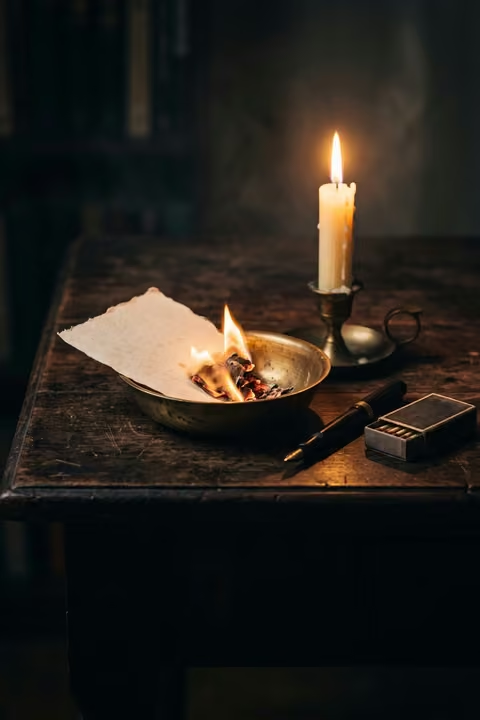
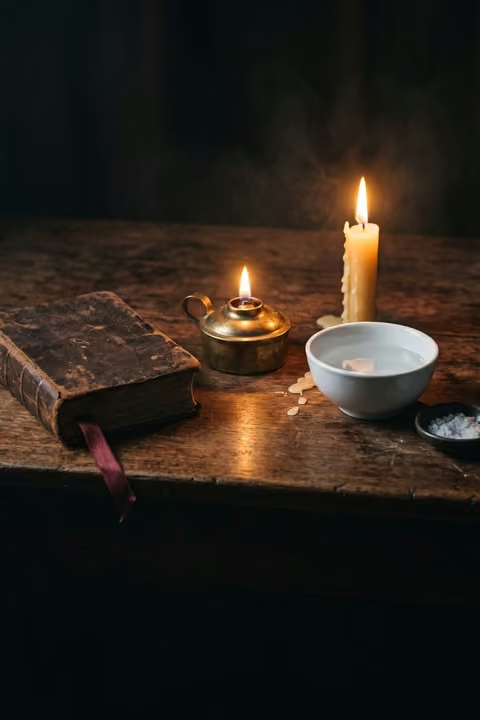
A single candle is enough, white if possible, in beeswax or virgin wax, as natural as possible. You light it at every ritual.
It stands for the divine light. Its Hebrew name, Ner, is worth 250, a number that recalls the Kavanah, the intention of the heart. You can engrave divine names on it, or use a candlestick that bears them.
The basic incense
A blend of three resins in equal parts: myrrh, frankincense and benzoin.
The three resins match the three planes of the soul: myrrh the Neshamah, frankincense the Ruach, benzoin the Nefesh. Other scents are added, chosen for the ritual and the effect you want; often, the ritual does not name them.
Moses’s incense
The incense God gives Moses in Exodus: each ingredient in the same weight.
It holds pure frankincense, galbanum, onycha (sweet flag) and storax. Other blends also carry this name; this one follows the text of Exodus.
Manna
The scent usually burned for success, at work as in trade.
It is the name of the food God sends the Hebrews in the desert. The manna of Sinai is a resin, most often from the tamarisk; ash trees and a lichen also give it. Tradition links it to Jupiter.
Benzoin
A resin for exchanges: those of trade as well as those made with spirits.
It is linked to Mercury. White benzoin crumbles easily and mixes white, grey and light brown. Grey benzoin, a little darker, keeps its scent longer and helps concentration.
Storax
A resin with a heavy, sweet scent, for requests that touch on material things.
It looks like peat or potting soil, only lighter. It is burned in rites to find a job or to sign a contract.
Dittany of Crete
An oregano from Crete, linked to material success.
It helps make what you ask for concrete and anchor it in matter. Burned, its downy leaves give a fragrant, very dense smoke. As the base of a blend, it holds the scent of the other plants and strengthens the effect.
Myrrh
A resin that raises a request, spiritual or material, then anchors it.
It is part of the basic incense, with frankincense and benzoin. A few drops of its resin, diluted in alcohol, can also go into the ink for Qamyot.
Mandrake
A root to ask for a divine grace that changes your material situation.
There are two: the white, called male, and the black, called female. In the rites of the Kabbalah, this is the root that is used. Its Hebrew name is Duda, Dudaim in the plural, from the same root as Dodi, the beloved, and Dodim, love and caresses: hence its role as a symbol of love, up to unbridled love. Genesis tells how Rachel asks Leah for her son’s mandrakes, and the Song of Songs mentions it. Beware: some traditions took it as a drug, and it holds dangerous alkaloids, which cause torpor and, in a high dose, anesthetize and cause hallucinations.
Cinnamon
A spice long seen as a sign of wealth; it is used to obtain a divine grace.
It is used when a situation no longer moves and you ask for it to change completely. As an essential oil, it goes into anointing oils, to call down divine grace and to consecrate an object or a Qamya.
Anointing oils
Oils used to consecrate; their base is most often virgin olive oil, cold-pressed.
Essential oils, plants, rose water or orange-blossom water are added. Cinnamon oil, which draws blessings, goes into the oil called Abramelin oil. Some uses of the psalms call for rose oil, which is costly as an essential oil: a sweet almond oil well charged with rose can replace it.
Parchments
The material a Qamya is written and consecrated on. There are two kinds.
Plant parchment is for small work, for a talisman that is not meant to last; papyrus can replace it. Animal parchment, goat, calf or sometimes deer skin prepared for writing, is for major work: it better holds its charge, the force you put into it, and keeps longer.
Ink
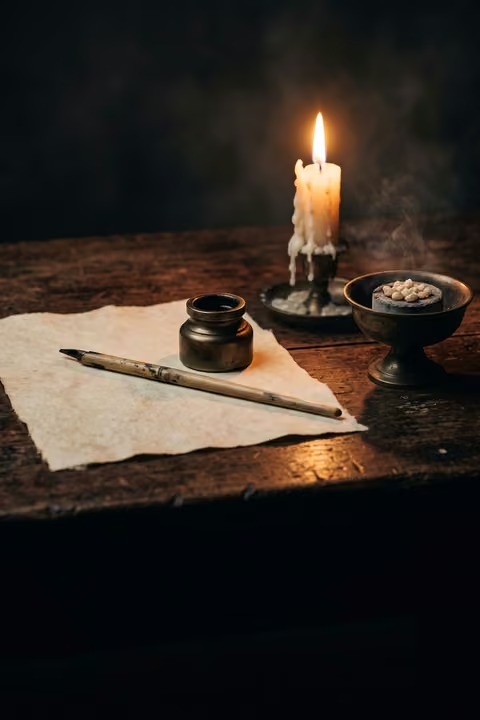
An ink as natural as possible, with no added chemicals, preferably black.
India ink is made of lamp black, bound with skin or fish glue, or with shellac. So-called magic inks add plants or resins to it.
The pen
The tool for writing a Qamya.
For seals and verses, Christian magic uses a quill; for Hebrew, the Jewish tradition uses a calamus, a cut reed. A fountain pen you keep for talismans alone works too.
Segulot
Charms of the Jewish tradition, to protect and help in everyday life.
In the singular, a Segulah. They cover protection, health, marriage, children’s health and prosperity. They are small everyday acts, like recipes, through which faith in God finds expression.
Qamyot
Talismans written on parchment or blank paper: they fix the intention of a ritual in our world.
In the singular, a Qamya. It is a written prayer that mixes names of God, names of angels and formulas of Kabbalah. They are written in Hebrew, even in the Christian tradition, and often with coded alphabets.
Protective incenses
Frankincense, camphor, myrrh, asafoetida, gum ammoniac: each for what it keeps away.
Against circling thoughts and obsessions, frankincense recentres the emotions and camphor calms the mind. Against thought-forms born of ill will, myrrh lifts and purifies the mind; asafoetida as a resin, black fassoukh, and gum ammoniac drive them away and dissolve them. Against the evil eye, asafoetida mixed with harmel; against negative influences, gum ammoniac.
Red sandalwood
A wood from India with a soft scent that heightens sensuality and desire.
It comes from India and Ceylon. Only its scent matters, whether the wood is red or white: you reduce it to powder or shavings so that it gives off its smell. Red sandalwood is Venusian in nature and goes into incense compositions to heighten sensuality and desire. Its extract also goes into the ink of the Qamyot (talismans) of love and sexuality.
White sandalwood
Lighter and fresher than the red, it is tied more to friendship than to love.
It belongs to a friendly relationship more than a loving one. Prefer its essential oil: the wood powder quickly loses its scent when it is not fresh. As with the red, only its smell matters.
Labdanum
A resin with an amber scent, tied to Venus, used to strengthen your defense.
This resinous gum comes from the rockrose shrub. In fumigation, notably in the East, it is burned as a perfume to draw the favor of the gods. In fumigation it is also used to undo the obsessions one person holds over another, love spells and fixations.
Vanilla
A sensual perfume, generally feminine, meant to draw men’s appetites.
Its scent is carnal. It is the fruit of certain tropical climbing orchids, most often from South America. Vanilla pods were found in funerary jars in Israel, 3,600 years old, set in olive oil: it served as an anointing oil.
Nard
A highly aromatic plant, a symbol of delight, royalty and the search for a soulmate.
The ancients drew a very precious perfume from it. The Song of Songs mentions it for the king, then to symbolize sublimated love and the search for the soulmate, the Zivug. In the rites only its essential oil is used, either as a perfume or mixed with a vegetable oil as an anointing oil.
Myrtle
A Mediterranean plant tied to Venus, used to purify harmful loves.
It grows in Mediterranean regions. It is traditionally tied to Venus, and it is used above all as an essential oil. Magically, it is used to purify harmful loves and adultery, and so that a person stays chaste, or at least appears to, and keeps her single status without offending the intentions of her suitors.
Patchouli
A very strong, lasting scent that draws men’s sexuality and stirs great passions.
Patchouli comes from Malaysia, and its leaves have a very strong, lasting smell. It is assigned sometimes to Mars, for the power of its scent, which draws men’s sexuality, sometimes to Venus, for the sensuality of its smell, which stirs great passions. The passions it provokes become hard to control. Its scent is as heady as that of Indian nard, but far more sensual.
Olibanum
Frankincense resin, tied to the Sun, for balance and spiritual elevation.
It is also called male incense. This gum resin is taken by cutting the bark of boswellia trees, in eastern India and above all in Africa, and gives off a balsamic smell as it burns. It is always attributed to the Sun. You burn it when a rite calls for balance and spiritual elevation.
Saffron
A solar, glorious perfume, for seeking recognition and love.
Saffron is a bulbous plant of Mediterranean origin; the stigmas of its flower are used. Its fumigations create a scent too insistent to be kept up for long: dose it very lightly, because in an incense blend its scent overpowers all the others. It is solar and glorious above all, and serves in several Qamyot (talismans) where recognition and love are sought, as a perfume and as an ink.
Rose
One of the most sacred perfumes, for divine, human and sensual love.
It is used as an anointing oil, as a perfume and as a floral water, for divine love, human love and sensual love. Rose water and rose oil alike go into many love rites. Its essential oil is expensive: a blend of vegetable oil, such as sweet almond, with a good amount of rose can do the job.
Lily ink
An ink made by steeping lily stigmas in rose water.
Lily stigmas dye strongly. You steep them in rose water until it is saturated with the tincture. This ink serves above all in love Qamyot (talismans), for charms tied to feeling in all its forms and for the search for the soulmate, the Zivug.
Saffron ink
A rose-water ink in which saffron stigmas are diluted.
Saffron stigmas, which dye strongly, are diluted in rose water. Coptic magicians write a psalm or a talisman with a special ink generally made of rose water, musk essence and saffron. To draw it, you take a calame, a cut reed, or a fountain pen you keep for talismans alone.
The Chotamot
Seals: compositions of symbols and letters that designate the signature of an angel or another entity.
In the singular, a Chotam, usually translated as seal, sometimes as characters. It is a composition of symbols and letters that designates the signature of an angel or another entity. Angels most often pass them on to certain practitioners. They are used above all in magic and theurgy, combined with Segulot (charms), divine names, angel names and names of power. They appear in Judaism, Christianity, Islam and some ancient pagan magics.