North Node in Capricorn
You are very sensitive, to your own emotions as much as to other people’s.
Your North Node in Capricorn shows the direction that makes you grow; your South Node, in Cancer, shows what you already do out of habit.
The lunar nodes form an axis: the South Node is what is familiar to you, the North Node is where you are headed.
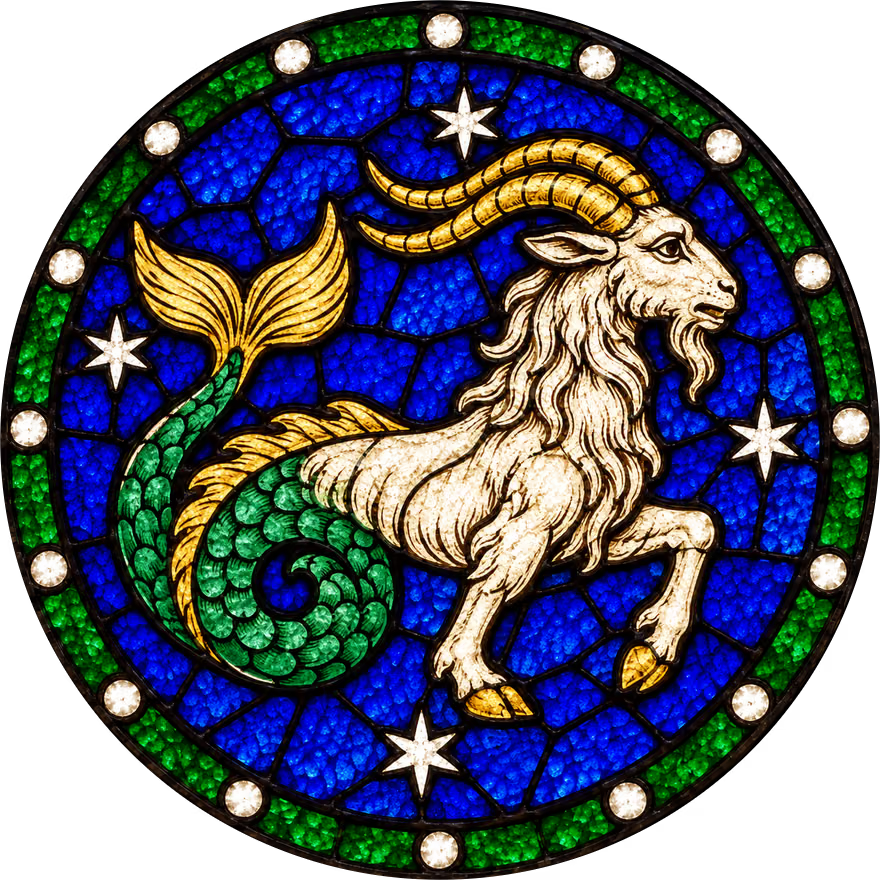

- Planet
- North Node
- Sign
- Capricorn
- Element
- Earth
- Earth is the element of Taurus, Virgo and Capricorn: the concrete, the reliable, the real.
- Modality
- Cardinal
- The cardinal modality belongs to Aries, Cancer, Libra and Capricorn: starting, launching, making things change.
- Ruler
- Saturn
- The planet that rules this sign.
What it means
Your feelings are very present: you cry at a film or a sad story. You pick up on everything that passes between people, the words, the feelings, the gestures, and when you are told about a decision, you immediately sense the conflicting feelings behind it. You have a great need for security and a deep need to belong to a group. You are loyal and attached to your country, which you experience a bit like a big family.
At bottom, you want a place where you feel protected, surrounded by care and where you truly belong. What you need most is to respect yourself. You sense that there is work you are meant to do, and as long as you don’t do it, you feel unsatisfied and guilty. This work always involves a position of authority, a responsibility to take on, an ideal to represent or a truth more important than your personal life. You like having role models: people whose mind, presence, ease with words or success you admire. With time, you may set yourself up as a defender of tradition, and you make sure no outsider learns what in your private life contradicts the principles you defend.
Your emotions can overwhelm you to the point that you can no longer think or act, especially in the face of a personal loss, or at work when there is a conflict or you have to prove yourself. As soon as something becomes too important to you, anxiety rises. An unexpected event or new information can make your emotions overflow and cloud your thinking: you do better when you have time to think before deciding. You believe you are bad at expressing yourself, when you only lose your words once emotion overflows. You are often very intelligent and understand easily, but putting your ideas into practice is a struggle.
If someone rejects you, you hold yourself responsible, and you take it as proof that you aren’t worth much alone. You put off the moment of being fully adult: you always need more help, more advice, more confidence, more practice first. You handle the small daily responsibilities well, but you avoid the big questions of your life. You can stay without direction for a long time; you can also succeed early, but it is often in the second half of your life that you finally take a stand.
What you already have
You have gotten into the habit of living centered on home and family: you know how a family works and you naturally tune in to what others feel. You are also used to being protected and looked after, and you expect others to help you put your life back in order. You feel safe in your routines: getting up, eating, coming home and going to bed at set times. You hold on to the past: you keep everything, objects, memories, relationships, you find it hard to say goodbye, and you often think about what you should have done back then. You stay in a situation that no longer works until you have no hope left. When you settle into this familiar ground, you depend on others, avoid looking at the problems that make you uncomfortable, and count on your emotional reactions to make others change. These abilities have value; the risk is retreating into them to avoid the effort of moving forward.
Where to grow
Capricorn teaches you to become an adult who takes her life in hand and takes responsibility for it. You grow when you set yourself a precise goal and truly commit to it: that is what takes you out of your emotions and gives your life a direction. You gain by looking toward the future, planning, and understanding the overall goal well so that you trust your role. You also gain by committing to an ideal bigger than your personal life and defending it despite your difficulties. When you learn to stop reacting too sharply under the pressure of emotion, you can become methodical and careful in your projects. You grow by bringing your life in line with principles of honor, respect and tradition. The qualities to develop: self-mastery, an adult attitude, self-respect, steadiness toward a goal, reasonable solutions to problems, keeping your commitments and promises, letting go of the past, looking after yourself, owning your success. As soon as you take things in hand, you feel safe and in charge of your life.
Your strengths
- You sense what others are going through and understand their needs, which lets you lead without putting anyone down.
- You are good at leading: people cooperate willingly with you.
- You know how to encourage and reassure.
- You are hardworking and resilient: despite dark moods, you always get back up.
- Your emotions are a real strength when you put them at the service of a goal.
- Others can take you as an example.
- Your strength grows with age.
What holds you back
- You wait for someone to take care of you, and you look for a security that is never enough for you: dependence is your most vulnerable point.
- You feel responsible for other people’s moods: to spare them an annoyance, you change your plans and accept what you don’t want.
- You let your moods rule you, and you try to control others through your emotional reactions so that everything goes your way.
- You make excuses for yourself when you don’t feel like making the effort, with the same indulgence you show others.
- Especially when young, you try to attract attention, sometimes by being sullen or sharp; then you resent yourself when you feel you are getting too much of it.
What helps
- Setting yourself a precise, realistic goal, then small steps that you know you can reach.
- Keeping your word, being on time, being honest and doing what earns you self-respect.
- Asking yourself before acting whether this act will earn you self-respect, whatever the outcome.
- When emotion overflows, slowing your breathing, relaxing and thinking of a happy, peaceful memory.
- Setting your limits from the start: saying what time you need to be finished when you do someone a favor.
- Asking others directly why they reacted that way, then listening to their answer.
- Daring to say you don’t know, then finding out and getting back to the person.
- Going out regularly, and choosing the people with whom you feel you belong.
- Recognizing your progress and looking after yourself.
Phrases that help
- “I have no hold over other people; I have one over myself.”
- “When I take things in hand, I manage.”
- “If I respect myself, I am on the right track.”
- “I don’t need to depend on anyone to take care of myself.”
Careers
Team leadership, public speaking, politics, starting a business.
Love
You believe you need a strong person to protect you, and you sometimes attract someone who wants to look after you and keep you at home; over time, something in you rebels and you end up pushing that person away. You need someone who helps you develop your own authority, personal and professional. As soon as you feel at home in a relationship, you tend to leave all the power and all the decisions to the other person, and you then risk losing their respect and their love. Your life revolves around the other person; if they leave, you lose your footing, even at work. You don’t say what hurts you, you take on too many small tasks for fear of losing the other person, then you become silent and angry. Addressing a problem as soon as it appears, keeping the purpose of the relationship in mind, protects your bonds. Saying no calmly, explaining why, and sticking to it gives you self-respect. Stepping back from the other person’s emotions and letting them be themselves frees you. Your fulfillment comes mostly from your own goals; when you pursue them, you more easily attract someone who supports you.
Work
You succeed better when you are responsible for your own part of the work. Jobs centered on caring for others often leave you powerless; those aimed at a goal suit you better. You tolerate clumsy or insensitive management poorly: you criticize, you have plenty of ideas about the right way to do things, but at the last moment you let the other person lead and only offer your help. Asking for a promotion, or calmly saying what hurt you, helps you. Accepting recognition for your work can open other responsibilities to you. Over the years, you gain strength, credibility and authority in your career.
Money
Taking charge of yourself also means providing for your own needs. Out of fear of losing the security of your daily life, you avoid risks, even to prepare your future; building a financial base early serves you.
Family
Often, in your family, your relatives have many emotional problems, and their demands wear you out. You take their problems on yourself without feeling able to help them change. Stepping back from your emotional involvement in the family lets you move forward; you then manage your family very well, approaching it with authority and no longer from your own need. As a parent, you often act like one of the children and hesitate to take on your role. Setting clear rules for your children and sticking to them, even if they get angry, keeps their respect and your own. Giving yourself a goal for each child, rather than following their mood of the moment, helps you stay calm. You often devote a good part of your strength and attention to the youngest.
Friendships
When a misunderstanding comes up with a friend, telling her from the start that you want to get closer helps; often, she didn’t even know she had hurt you.
Home
Your home and belongings matter a great deal for your security, but too much time at home keeps you living in routine.
Meaning and inner life
Connecting to a spiritual belief or a higher power helps you move past your emotional needs and let go of what you don’t control. When you put the common good before your comfort, you feel love and a sense that it is right.